
Market
Amravati, Akola and Yavatmal mandi bhav: how to read tur and chana rates
Every morning, thousands of farmers and traders check the Amravati, Akola and Yavatmal mandi bhav. Most read only the highest number. Here is how to read all of it.
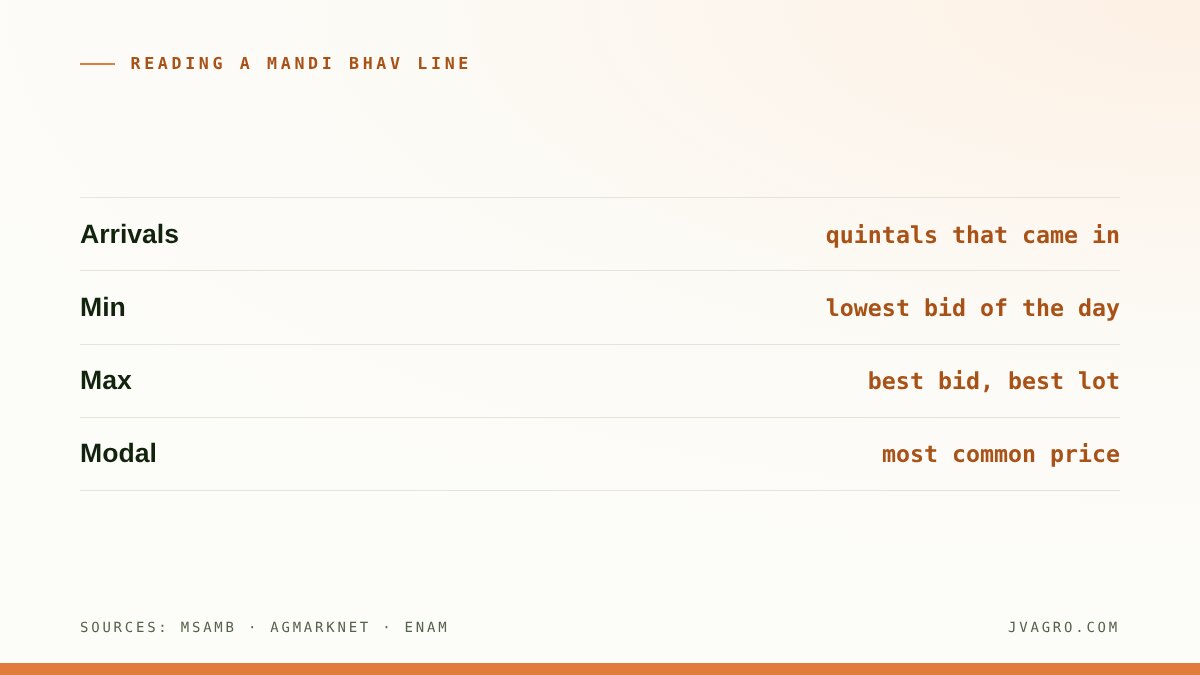
Key takeaways
- A mandi rate line has arrivals, minimum, maximum and modal price. The modal price is the most useful number.
- The maximum is usually for a small quantity of the best lot. Do not expect it for an average lot.
- Official daily data is published by MSAMB (Maharashtra State Agricultural Marketing Board), Agmarknet and eNAM.
- Watch arrivals alongside price: rising arrivals with stable prices signal strong demand.
Vidarbha's main pulse markets include Amravati, Akola, Yavatmal, Washim, Karanja, Achalpur (Paratwada), Malkapur and Khamgaon, among others. Their daily rates move the tur and chana trade across central India. Here is how to read them properly.
The four numbers on a mandi rate
| Field | What it means |
|---|---|
| Arrivals | How many quintals of the commodity came into the market that day |
| Minimum price | The lowest price paid that day, usually for poor or damp lots |
| Maximum price | The highest price, usually for a small quantity of the best lot |
| Modal price | The price at which the largest quantity traded; the best guide to the day's market |
Why the modal price matters most
Newspapers and WhatsApp messages often quote only the maximum. But the maximum may be for ten bags of exceptional grain. The modal price tells you what most farmers actually got. Plan your selling or buying on the modal price, and judge where your lot fits between minimum and maximum by its quality.
Arrivals tell you the direction
- Arrivals rising, price falling: supply is outpacing demand. Common at the start of the season.
- Arrivals rising, price steady or rising: strong buying, often from mills stocking up.
- Arrivals falling, price rising: farmers are holding back, or the season is ending.
- Arrivals falling, price falling: weak demand; buyers are waiting.
Quality: FAQ and non-FAQ
Mandi rates assume fair average quality (FAQ) unless stated. Damp, dirty, mixed or damaged lots trade below FAQ. Bold, clean, dry lots trade towards the maximum. A farmer who cleans and dries a lot well can move it from the modal price towards the top.
Where to find official rates
- MSAMB, the Maharashtra State Agricultural Marketing Board, publishes daily APMC rates for markets across the state.
- Agmarknet, the central government's agricultural marketing portal, carries rates and arrivals for markets across India.
- eNAM, the national electronic market, shows rates for markets connected to it.
- APMC notice boards at the market itself.
Comparing mandi bhav with dal rates
Mandi bhav is for raw tur or chana. Dal rates are higher because only about 70 to 80% of the grain becomes dal, and milling, bags and freight are added. Our rate board shows ex-mill dal rates every working day, so you can see both sides.
For a quick sense of the market, compare the modal price at three markets on the same day, such as Amravati, Akola and Latur. If one is far out of line, check arrivals and quality there before reading too much into it.
Quick answers
The modal price is the price at which the largest quantity of a commodity traded that day. It is the best single guide to the market.
On the MSAMB website, Agmarknet and eNAM, and on the APMC notice board.
The maximum is often paid for a small quantity of the best-quality lot. Most of the day's trade happens near the modal price.
Sources
Want the mill rate, not just the mandi rate? Our daily rate board shows ex-mill dal rates alongside the market.