
Glossary
The dal trade, in one line per word.
44 terms you will hear in a mandi, a mill or a contract, from APMC to weevilled grain.
A
- Aflatoxin
- A toxin produced by moulds on badly stored grain. FSSAI caps it at 30 µg/kg in tur dal.
- APEDA
- Agricultural and Processed Food Products Export Development Authority. Exporters of pulses register with it for an RCMC.
- APMC
- Agricultural Produce Market Committee: the regulated market yard (mandi) where farmers sell and traders buy through licensed agents.
- Arrivals
- The volume of new crop reaching the mandis. Heavy arrivals usually mean softer prices.
B
- Besan
- Flour milled from chana dal (de-husked desi chickpea).
- Bilty
- The lorry receipt issued by a transporter for goods booked with it; a 'bilty' purchase is grain bought from outside the local mandi and delivered by truck.
- Buffer stock
- Pulses held by the government (largely through NAFED) and released to cool prices when they spike.
C
- Calibre
- The size of a grain, measured by the screen aperture it passes over, such as 8, 9 or 10 mm for kabuli chana.
- Chana
- Chickpea (Cicer arietinum), also called gram or Bengal gram. India's largest pulse crop.
- Chilka
- With the skin on. Moong chilka is split moong that still carries its green skin.
- Chuni
- By-product of dal milling: husk, powder and broken bits, sold as cattle feed.
- CIF
- Cost, Insurance and Freight: an export price that includes sea freight and insurance to the buyer's port.
- Conditioning
- Treating pitted grain with oil or water so the husk loosens before de-husking.
- Count
- Number of grains per 100 g, used to express kabuli chana size. A lower count means bigger grain.
D
- Dal
- A pulse with its husk removed and the seed split into two halves.
- Desi chana
- The small, dark, angular chickpea. Becomes kala chana, chana dal and besan.
E
- Ex-mill
- A price for goods collected at the mill gate, before freight.
- Extraneous matter
- Anything in a lot that is not the pulse: dust, stones, straw, other seeds. Max 1% in tur dal under FSSAI.
F
- FOB
- Free on Board: an export price up to the goods being loaded on the vessel at the Indian port.
- FSSAI
- Food Safety and Standards Authority of India, which sets food standards and licenses food businesses.
G
- Gota
- A whole pulse with the husk removed but not split, such as urad gota.
H
- HS code
- Harmonized System code used in trade. Dried pulses fall under heading 0713; tur is 0713 60.
I
- IEC
- Importer Exporter Code, issued by DGFT. Needed for any import or export.
- Import parity
- The landed cost of imported grain. When it is below the domestic price, it caps the domestic market.
K
- Kabuli chana
- The large, cream-coloured chickpea, sold by size and used whole in chole, salads and hummus.
- Kala chana
- Whole desi chickpea with its brown-black skin.
- Kharif
- The monsoon crop season. Tur, moong and urad are sown in June and July.
L
- Landed cost
- The full cost of grain delivered to your door: price, freight, loading, taxes and handling.
M
- Masoor
- Lentil (Lens culinaris). Red masoor dal is the de-husked, split form.
- Moisture
- Water content of grain by weight. FSSAI allows at most 14% in tur dal; lower keeps better.
- Moong
- Green gram or mung bean (Vigna radiata). Yellow moong dal is de-husked and split.
- MSP
- Minimum Support Price: the price at which the government stands ready to buy a crop from farmers. Tur MSP for 2025-26 is ₹8,000 a quintal.
N
- NAFED
- National Agricultural Cooperative Marketing Federation of India, a main agency for procuring pulses at MSP.
P
- Pitting
- Lightly scratching the seed coat before conditioning so oil or water can penetrate.
- Polishing
- A finishing step that tumbles dal with water or edible oil to make it look brighter. Unpolished dal skips it.
- PSS
- Price Support Scheme under PM-AASHA, through which pulses are procured at MSP.
Q
- Quintal
- 100 kg. Mandi prices for grain are quoted per quintal.
R
- Rabi
- The winter crop season. Chana and masoor are sown in October and November.
- RCMC
- Registration-cum-Membership Certificate, issued to exporters by an export promotion body such as APEDA.
S
- Sortex
- An optical colour sorter that rejects discoloured grains and foreign matter with jets of air. A brand name now used for the machine type.
T
- Tur
- Pigeon pea (Cajanus cajan), also toor or arhar. Its split, de-husked form is the most eaten dal in India.
U
- Unit sale price
- Price per standard unit, such as ₹ per kg, which must be printed on packs alongside the MRP.
- Urad
- Black gram (Vigna mungo). Urad dal is the base of idli, dosa and dal makhani.
W
- Weevilled grain
- A grain with an insect hole. FSSAI allows at most 3% by count in tur dal.
Go deeper
Read the full notes
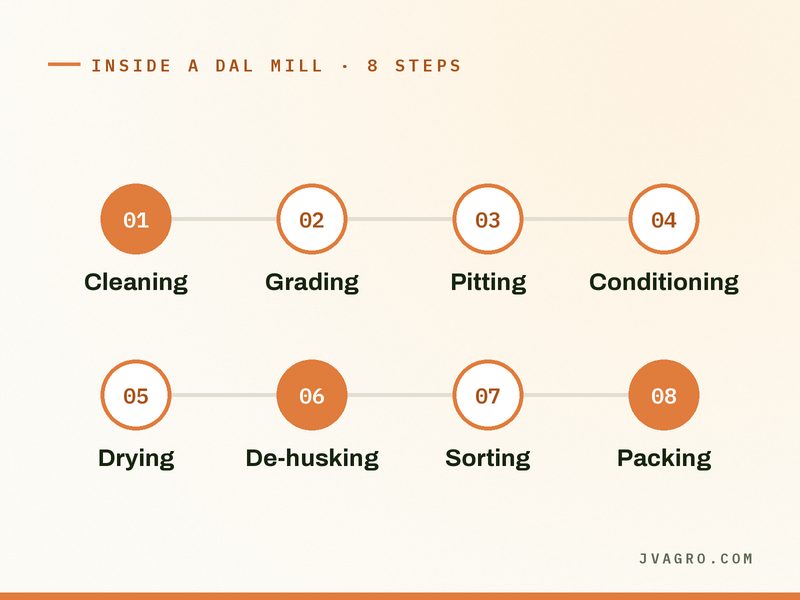
Process
How dal is made: inside a dal mill, step by step
From mandi tur to split yellow dal, in eight steps.
2 min read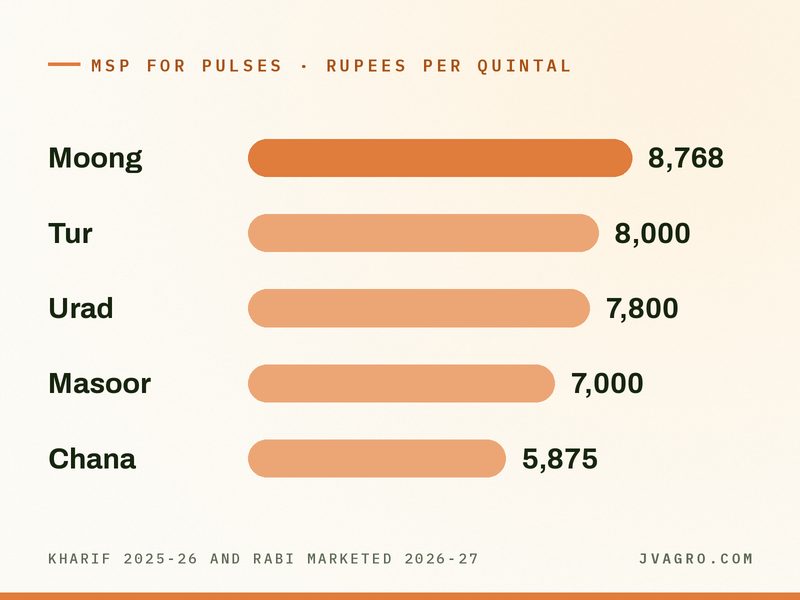
Market
MSP for pulses 2025-26: tur, chana, moong, urad and masoor
The support prices that set the floor under India's pulse market this year, in one table.
2 min read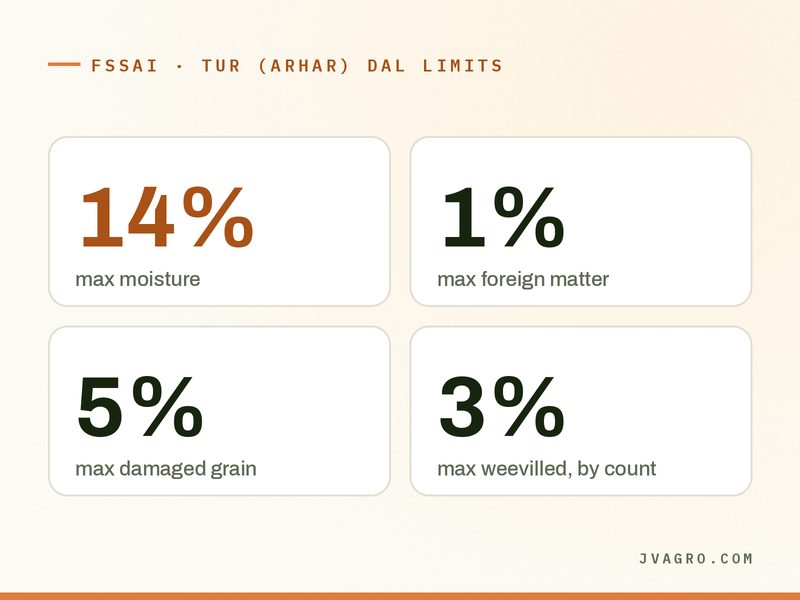
Compliance
FSSAI standards for tur dal, in plain English
The legal limits for moisture, foreign matter and damaged grain, and what they mean when you inspect a lot.
2 min readTell us what you need and we will come back with a number.
Product, quantity, packing and destination. That is all it takes to start.