
Business
How to start a dal distributorship: a practical guide
Registrations, godown, working capital, retailers and the questions to ask a brand before you sign. Written by a mill that appoints distributors.
Key takeaways
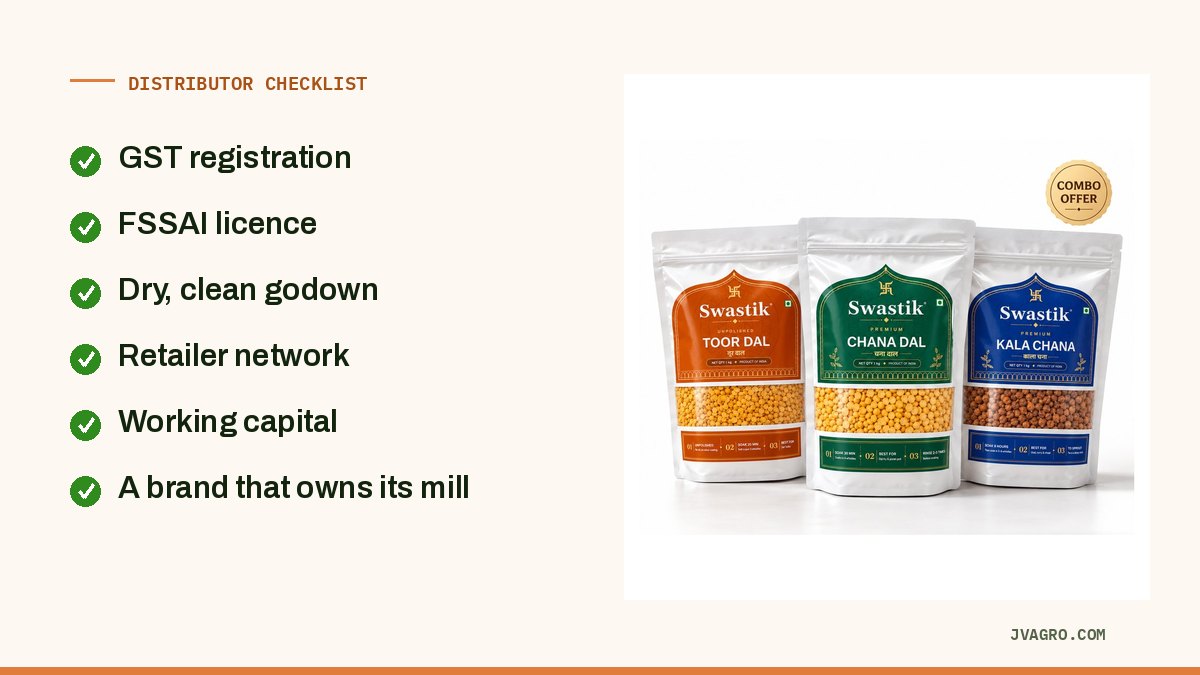
- You need GST, an FSSAI registration or licence for food trading, a dry godown and delivery capacity.
- Start with a territory you already know and retailers you already serve.
- Margin is made on rotation: stock that sells every week beats a bigger margin on stock that sits.
- Ask the brand who mills the dal, how replacements work and how often they can supply.
Dal is one of the few grocery lines every kirana in India stocks every week of the year. That makes distribution of a good dal brand a steady business — but only if the basics are right. This guide is what we walk new Swastik distributors through before the first order.
1. Registrations you need
- GST registrationNeeded to buy from manufacturers and invoice retailers. Most packaged dal attracts GST once it is pre-packed and labelled; check the current rate with your accountant.
- FSSAI registration or licenceAnyone who stores, distributes or sells food needs one. Small businesses can start with a basic registration; larger turnover needs a state licence. Apply on the FSSAI FoSCoS portal.
- Shop and establishment registrationRequired by most states for a business premises and godown.
- A current bank accountIn the business name, for clean payments to the brand and from retailers.
2. The godown
Pulses keep their quality only if they stay dry. The godown does not need to be large, but it must be dry, clean and pest-free, with stock on pallets and away from walls. Keep packed dal away from strong smells such as kerosene, detergents and spices, because pulses pick up odours. First in, first out: the oldest stock always leaves first.
3. Working capital and margin
Your money sits in three places: opening stock, stock in transit, and credit to retailers. The fastest way to run out of money is generous credit to shops that pay slowly. The fastest way to make money is rotation — a pack that leaves your godown within a week earns its margin four times a month, while a slightly higher margin on a pack that sits for a month earns it once.
Plan your opening order around the sizes your retailers actually sell. In most kirana stores, 1 kg packs move fastest, 500 g packs suit smaller households and 2 kg packs suit families and repeat buyers.
4. Your retailer network
Start with the shops you already supply. A distributor with 50 regular retailers in one town is far more valuable to a brand than one promising 500 across a district. Visit each store on a fixed day, check the shelf, take the order and collect payment in the same visit.
5. Questions to ask a dal brand before you sign
- Who mills it? A brand that owns its mill controls quality; one that buys and repacks may change source without telling you.
- How often can they supply? Gaps in supply lose shelf space you may never get back.
- How do replacements work? Torn or damaged packs happen; the policy should be written down.
- Is the label complete? FSSAI number, batch, pack month, net weight and a consumer-care number.
- What territory is yours? Agree the boundary so you are not competing with another distributor of the same brand.
- Is the brand visible to shoppers? Online listings help shoppers recognise the name on the shelf.
6. Growing the shelf
Once the first product moves, add the rest of the range so a retailer can stock the full set from one supplier. Combos and family packs lift the value of each order. Track which shops reorder and which do not, and spend your time where the repeat orders are.
Quick answers
Yes. Anyone who stores or distributes food needs FSSAI registration or a licence, depending on turnover. Apply on the FSSAI FoSCoS portal.
In most stores the 1 kg pack moves fastest, followed by 500 g. 2 kg packs suit family buyers and regular customers.
Share your territory, the retailers you supply and the volume you expect on our distributor page or WhatsApp, and the trade desk will call you back.
Want to distribute Swastik? Unpolished dal from the mill, in 500 g, 1 kg and 2 kg packs and combos.