
Buying
Buying toor dal wholesale: grades, rates per quintal and a 12-point checklist
Whether you run a restaurant, a hostel kitchen, a kirana chain or a repacking unit, the same twelve questions decide whether a bulk tur dal deal is a good one.
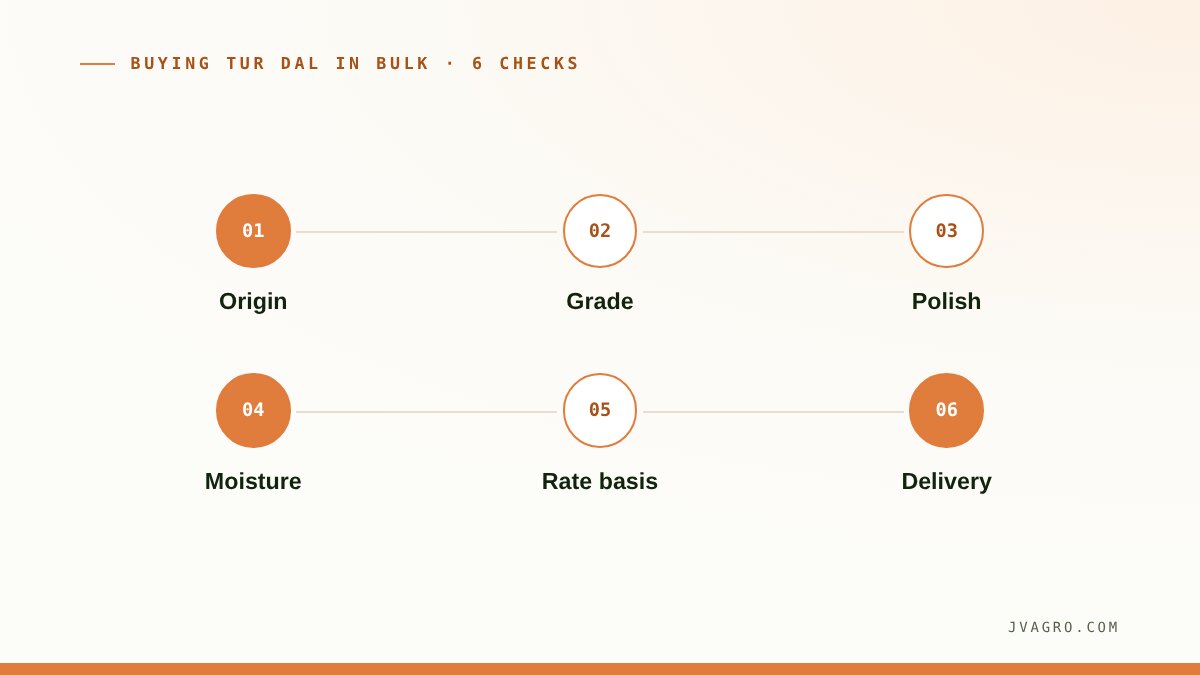
Key takeaways
- Tur dal is quoted in ₹ per quintal (100 kg). Divide by 100 for the rate per kilo.
- Always confirm grade, polish, origin and whether the rate is ex-mill or delivered before comparing two quotes.
- Check moisture (legal maximum 14%), foreign matter, brokens and colour on a fair sample.
- Buy from the mill where you can; each trading layer adds a margin.
Tur dal is the single biggest dal line in most Indian kitchens and shops. Buying it well in bulk is mostly about asking the right questions before money changes hands. This is the checklist we would use if we were on the other side of the table.
How tur dal is graded in the trade
Tur dal is not one product. In the wholesale market it is sorted by grain size, colour, brokens and finish. Every mill uses its own grade names, so names alone mean little. What matters is the specification behind them.
| Factor | What to look for | Why it matters |
|---|---|---|
| Grain size | Bold, medium or small, even within the lot | Bold uniform dal looks better and cooks evenly |
| Brokens | Percentage of split or broken pieces | Brokens cook faster and can turn mushy |
| Colour | Even golden-yellow, no dark or green grains | Discolouration suggests old or immature grain |
| Finish | Unpolished, water-polished or oil-polished | Changes look, shelf life and labelling |
| Foreign matter | Stones, husk, other seeds | Legal limit is 1%; good commercial lots are far lower |
Polished or unpolished?
Polished tur dal shines on the shelf because the mill coats it with a little oil or water, or polishes it with leather rollers. Unpolished dal looks duller and more natural. Many households and health-conscious buyers now ask for unpolished. For a restaurant, both cook well; for retail, the choice depends on your customer. Read the full explainer: polished vs unpolished toor dal.
From rate per quintal to cost per kilo
A rate of ₹11,800 a quintal ex-mill is ₹118 a kilo at the mill gate. Add freight, unloading and any GST if the dal is pre-packed and labelled, and you have your landed cost per kilo.
Ask whether the rate is ex-mill (you arrange transport) or delivered (FOR your city). Ask whether bags are included and whether the weight is net of the bag.
The 12-point checklist
- Who mills it? A mill that owns its plant controls quality; a trader may change source from one lot to the next.
- What origin is the tur? Desi Vidarbha, Marathwada or Karnataka tur, or imported African or Myanmar tur, or a blend.
- What grade and grain size? Ask for the specification, not just a name.
- Polished or unpolished? And if polished, with what.
- Moisture? Legal maximum is 14%. Good lots are well below that.
- Foreign matter and brokens? Ask for percentages and check them on the sample.
- Can I see a sample from the actual lot? Not a showroom sample.
- What bag size? Common bulk packs are 25, 30 and 50 kg.
- Is the rate ex-mill or delivered? And who pays unloading?
- Payment terms? Advance, against delivery or credit, and at what difference in rate.
- What if the delivery does not match the sample? Agree it in writing.
- How often can you supply? A supplier who runs out mid-season costs you more than a few rupees a quintal.
How to sample a lot properly
Take dal from several bags and from the top, middle and bottom of each. Mix it on a clean sheet and draw your sample from the mix. Seal and label a portion and keep it. If a later delivery differs, that retained sample is your evidence.
How much to buy at once
Dal keeps well if it is dry and stored properly, but tying up cash in stock costs money. Most kitchens buy two to four weeks of requirement at a time and fix a season rate with the mill for regular deliveries. Large buyers book a part of the year's requirement during the arrival window, from December to March, when tur is most plentiful.
Quick answers
It changes daily with mandi tur prices, grade and polish. See our rate board for today's ex-mill tur dal rate, or message us for a delivered quote.
Mills usually supply from a few quintals upward. Truck-load quantities get the best rate because freight per kilo falls.
Ask for a sample from the actual lot, check moisture with a meter, look for even colour and size, and measure brokens and foreign matter on a counted sample.
25 kg, 30 kg and 50 kg bags are common for bulk tur dal. Retail packs are usually 500 g, 1 kg, 2 kg and 5 kg.
Get a wholesale tur dal quote Tell us the grade, quantity and delivery city. We reply with an ex-mill or delivered rate the same day.