
Export
APEDA registration (RCMC) for pulses exporters: who needs it and how to apply
Before your first container of dal or kabuli chana leaves India, you need an Importer Exporter Code, an FSSAI central licence and an APEDA registration. Here is the APEDA part, step by step.
Key takeaways
- Pulses are APEDA scheduled products, so exporters need APEDA registration, issued as an RCMC (Registration-cum-Membership Certificate).
- You need an IEC from DGFT first, plus PAN, GST, bank details and usually an FSSAI central licence.
- Apply online on the APEDA portal, pay the registration fee and upload documents.
- The RCMC is typically valid for five years. Keep it current and linked to your IEC.
The Agricultural and Processed Food Products Export Development Authority (APEDA) promotes and regulates the export of scheduled agricultural products, including pulses. If you export dal, kabuli chana, besan or other pulse products, APEDA registration is part of your basic paperwork, alongside the IEC and FSSAI.
Who needs APEDA registration
- Merchant exporters who buy pulses and export them.
- Manufacturer exporters, such as dal mills, that export their own production.
- Anyone claiming export benefits or using APEDA schemes for scheduled products.
Before you apply
- Importer Exporter Code (IEC) from DGFT, linked to your PAN.
- GST registration for the exporting entity.
- Bank account in the business name, with a cancelled cheque or bank certificate.
- FSSAI central licence for food export.
- Constitution documents for a company, LLP or partnership.
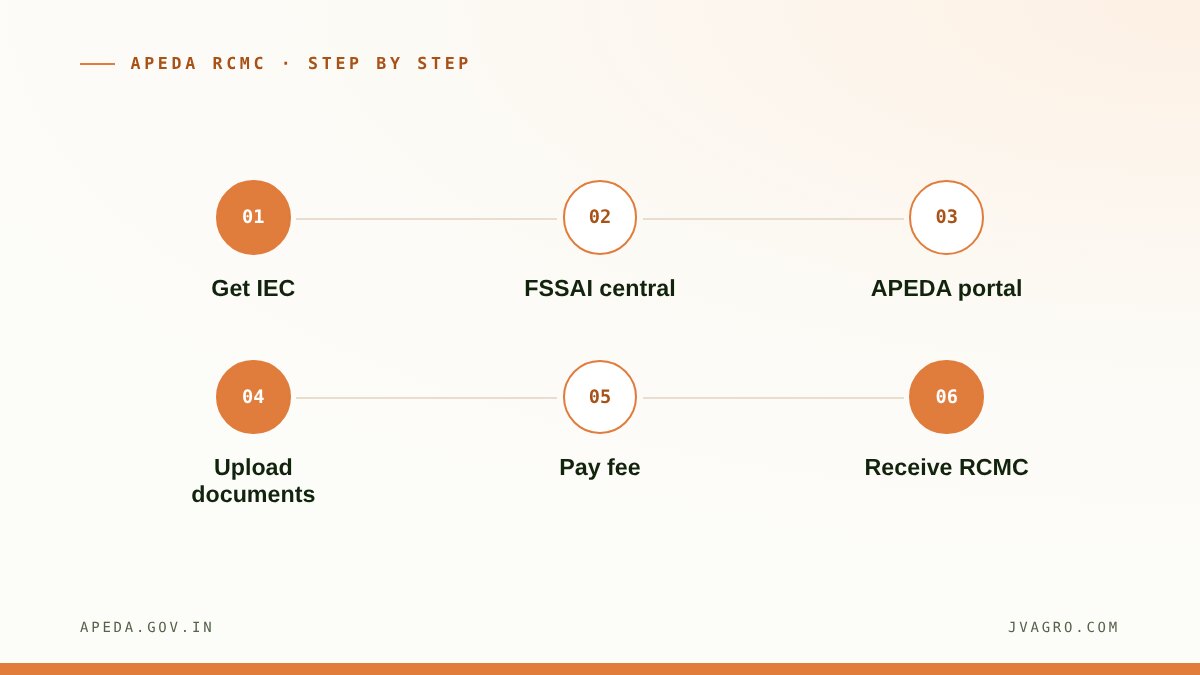
Applying, step by step
- Register on the APEDA portalCreate a login using your IEC.
- Fill in the applicationBusiness details, products you will export (choose pulses and the specific products), and whether you are a manufacturer or merchant exporter.
- Upload documentsIEC, PAN, GST certificate, bank certificate or cancelled cheque, and constitution documents.
- Pay the registration feeOnline, as listed on the APEDA portal at the time of application.
- Receive the RCMCAfter verification, APEDA issues the Registration-cum-Membership Certificate electronically.
Common reasons applications are delayed
- Name mismatch between IEC, PAN, GST and bank records.
- Wrong product selection, which causes problems at the shipping bill stage.
- Unsigned or unclear uploads.
- Address mismatch between documents.
What you need for each shipment
APEDA registration is a one-time step. Every shipment also needs its own documents: commercial invoice and packing list, shipping bill, certificate of origin, phytosanitary certificate from the Plant Quarantine authority, fumigation certificate where required, and any test reports or certificates the buyer or destination country asks for.
Most first-time exporters underestimate the destination country's import rules. Before you sign a contract, ask your buyer for their import permit conditions, pesticide residue limits and labelling rules, and check APEDA's market access information.
Quick answers
Pulses are APEDA scheduled products, and exporters register with APEDA and obtain an RCMC to export them and access APEDA schemes.
Typically IEC, PAN, GST certificate, bank certificate or cancelled cheque, and constitution documents for the business. An FSSAI central licence is needed for food export.
Typically five years from the date of issue.
Exporting dal or kabuli chana? We supply export-grade tur dal, chana dal and calibrated kabuli chana, with full documentation support.