
Export
Kabuli chana export from India: sizes, counts, markets and packing
Kabuli chana is one of India's most traded pulses abroad. Buyers speak in millimetres and counts, and they reject lots that are not uniform. Here is what an export buyer will ask you for.
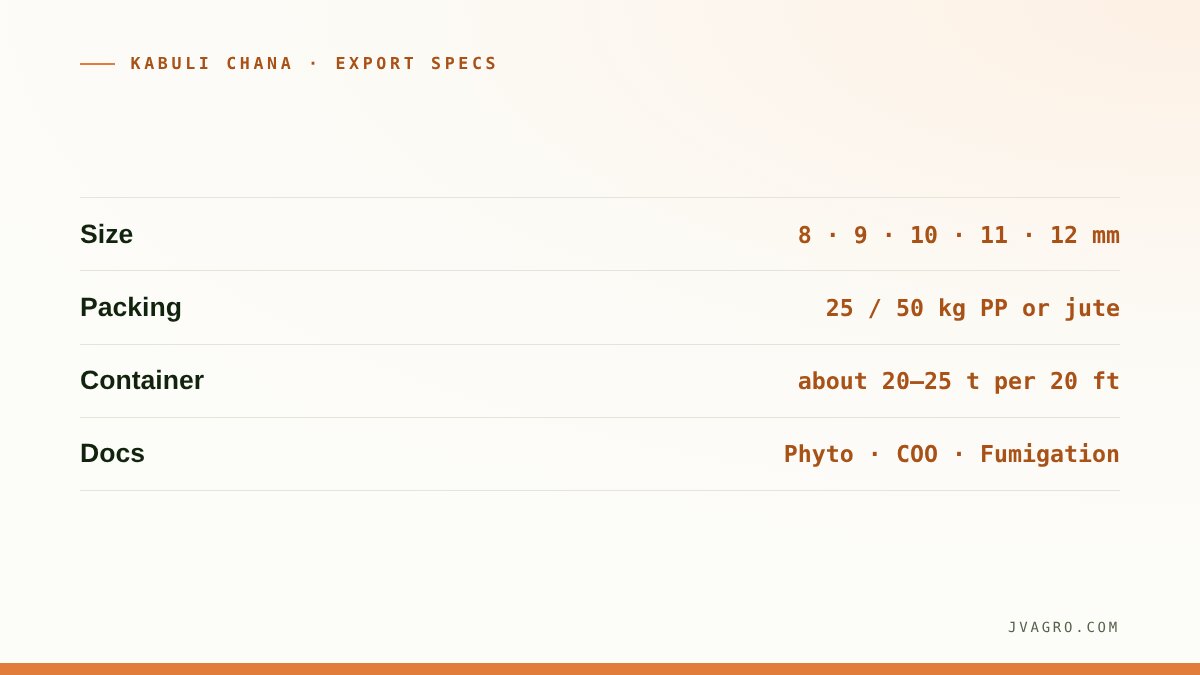
Key takeaways
- Kabuli chana is graded by size in millimetres (8 to 12 mm and above) and, in many international trades, by count per ounce.
- Buyers specify size uniformity, moisture, foreign matter, damaged and split grains, colour and insect freedom.
- Common packing is 25 kg or 50 kg PP or jute bags; a 20 ft container usually carries about 20 to 25 tonnes.
- Each shipment needs a phytosanitary certificate, certificate of origin and usually a fumigation certificate.
India grows a large kabuli chana crop in Madhya Pradesh, Maharashtra, Karnataka and Rajasthan. Indian kabuli is known for its bold size and cream colour. For export, the product is the same as for the domestic market, but the specification is tighter and the paperwork heavier.
How kabuli is sized
Millimetre sizes
In India, kabuli chana is calibrated through round-hole screens and sold as 8 mm, 9 mm, 10 mm, 11 mm, 12 mm and above. Larger sizes command higher prices.
Count per ounce
Many international buyers, especially those used to Mexican, Turkish or American chickpeas, quote by the number of grains in one ounce (about 28.35 g). A lower count means bigger grains. Be ready to give both.
| Parameter | What buyers commonly ask for |
|---|---|
| Size | A single calibrated size, with a tolerance for under-size grains |
| Moisture | Low, typically around 12% or below for shipping |
| Foreign matter | Very low, usually well under 1% |
| Damaged, split and weevilled grains | Low limits by weight |
| Colour | Uniform cream; few wrinkled or discoloured grains |
| Live insects | Nil |
Indicative. Every buyer has a specification. Write it into the contract with the test method and the inspection agency.
Packing and loading
- Bags: 25 kg or 50 kg PP or jute, new and clean, often with the buyer's marking.
- Liners: some buyers want inner liners or vacuum packs for retail-ready product.
- Containers: dry 20 ft containers usually carry about 20 to 25 tonnes depending on packing.
- Fumigation: often done before loading, as required by the destination.
Documents for each shipment
- Commercial invoice and packing list.
- Shipping bill filed through customs with the 8-digit HS code 0713 20 10.
- Certificate of origin, which may allow lower duty under a trade agreement.
- Phytosanitary certificate from the Plant Quarantine authority.
- Fumigation certificate, where required.
- Quality and weight certificate from an agreed inspection agency.
- Test reports for pesticide residues or other parameters if the buyer asks.
Pricing basis
Export prices are quoted FOB (free on board) at an Indian port, or CFR/CIF to the destination port, in US dollars per tonne. The domestic price of the calibrated size, the cost of sorting and packing, inland freight to the port, port charges and the exchange rate all feed into the quote.
The fastest way to lose an export buyer is a container that does not match the sample. Calibrate tightly, sort carefully, and send a pre-shipment sample from the actual lot.
Quick answers
All sizes are exported. Buyers in different markets prefer different sizes, commonly from 8 mm to 12 mm and above.
The number of chickpeas in one ounce (about 28.35 g). A lower count means larger grains.
Typically about 20 to 25 tonnes, depending on bag size and packing.
0713 20 10 in the Indian customs tariff.
Looking for an Indian kabuli chana supplier? Calibrated kabuli chana from Vidarbha, sorted and packed to buyer specification.