
Business
Buying dal in bulk for restaurants, caterers, hostels and canteens
A kitchen serving 500 plates a day uses well over a tonne of dal a month. Buying it well is part of food cost control. Here is how professional kitchens plan, buy and store dal.
Key takeaways
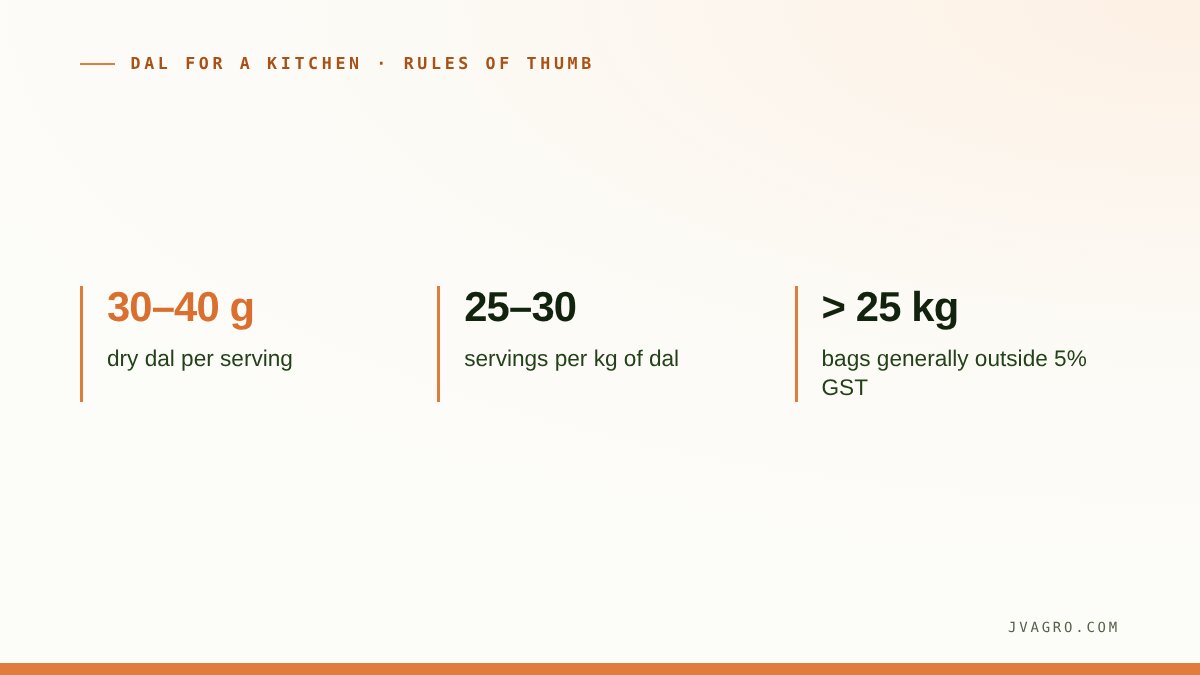
- Plan on about 30 to 40 g of dry dal per serving, so 1 kg feeds roughly 25 to 30 servings.
- Buy two to four weeks of stock at a time and fix a season rate for regular deliveries.
- Bags above 25 kg generally fall outside the 5% GST on pre-packaged and labelled dal. Confirm with your accountant.
- Store off the floor, away from walls and strong smells, oldest stock first.
For a restaurant, caterer, hostel or industrial canteen, dal is one of the few ingredients used every single day. A small saving per kilo adds up to real money over a year, and a reliable supplier saves even more in avoided stock-outs and complaints.
How much dal do you need?
| Dish | Dry dal per serving | Servings per kg |
|---|---|---|
| Dal tadka or dal fry | 30 to 35 g | about 28 to 33 |
| Sambar | 25 to 30 g | about 33 to 40 |
| Chana dal fry | 35 to 40 g | about 25 to 28 |
| Chole | 40 to 50 g kabuli chana | about 20 to 25 |
Indicative. Portion size, thickness and how many dishes are on the plate change the numbers. Track your own consumption for a month and plan from that.
A simple monthly plan
A canteen serving 500 meals a day, with dal in every meal at 35 g a serving, uses about 17.5 kg of dal a day, roughly 525 kg a month. That is a little over 5 quintals of toor dal, before sambar or chole.
Multiply by the number of dal dishes on your menu and you have your monthly requirement. Divide into weekly or fortnightly deliveries.
Choosing bag sizes
- 25 kg: easy to handle, common for retail-oriented bulk.
- 30 kg: common in Maharashtra for dal.
- 50 kg: lowest packing cost per kilo, heavier to handle.
For GST, packs above 25 kg are generally outside the "pre-packaged and labelled" definition, which can mean no GST on the dal itself. Confirm with your accountant for your invoices.
What to agree with your supplier
- Grade and specification, written down, with a reference sample.
- Rate basis: fixed for a period, or linked to the market.
- Delivery schedule and who unloads.
- Credit terms and the rate difference for advance or credit.
- Replacement policy for torn bags or off-spec deliveries.
- Backup supply in case of shortages.
Why unpolished dal suits kitchens
Unpolished dal carries no oil or water coating. It cooks evenly and tastes cleaner. Many institutional buyers now ask for it because it also reads well on menus and in contracts.
Storage in a kitchen store
- Pallets or racks, never directly on the floor.
- Away from walls, water lines and strong-smelling chemicals.
- First in, first out: label each delivery with its date.
- Airtight bins for open bags.
- Weekly checks for insects and damp, especially in the monsoon.
Quick answers
About 30 to 40 g of dry dal per serving for most dal dishes, so 1 kg of dal makes roughly 25 to 30 servings.
Packs above 25 kg are generally outside the pre-packaged and labelled definition used for GST and are typically exempt. Confirm with your accountant.
Both cook well. Unpolished dal carries no coating, cooks evenly and is increasingly preferred by institutional buyers.
Sources
Get a monthly supply quote for your kitchen Toor dal, chana dal, kala chana and kabuli chana in 25, 30 or 50 kg bags, delivered on a schedule.