
Buying
Crude vs refined cottonseed oil: what refiners check before they buy
Crude cottonseed oil is an industrial raw material, not a kitchen oil. Here is what refiners test in a tanker, what refining removes, and why fresh crude from a nearby mill is worth more.
Key takeaways
- Crude cottonseed oil is not for direct eating. It contains gossypol and other impurities removed by refining.
- Refiners check free fatty acids (FFA), moisture and impurities, colour and odour in every lot.
- Fresh crude, stored well and delivered fast, refines with lower losses.
- Refined cottonseed oil is a light, neutral oil widely used in cooking, frying and vanaspati.
Cottonseed is a by-product of cotton ginning. Crushed or expelled, it yields oil and cake. Vidarbha is one of India's largest cotton belts, which makes it a natural home for cottonseed processing. The oil that comes out of the expeller is dark and strong-smelling. It is a raw material for refiners.
Why crude cottonseed oil must be refined
Cottonseed contains gossypol, a natural pigment that protects the cotton plant. Gossypol is undesirable in food and gives crude oil its dark colour. Crude oil also contains free fatty acids, gums, moisture, fine meal and odour compounds. Refining removes them and produces a clear, light, neutral oil.
What refiners test in a lot
| Check | What it tells the refiner |
|---|---|
| Free fatty acids (FFA) | How much will be lost in neutralising; fresh oil has lower FFA |
| Moisture and impurities (M&I) | Water and meal that add weight but no oil |
| Colour | How hard bleaching will be; old or overheated oil darkens |
| Odour and appearance | Signs of age, heat damage or contamination |
| Phosphatides (gums) | How much degumming is needed |
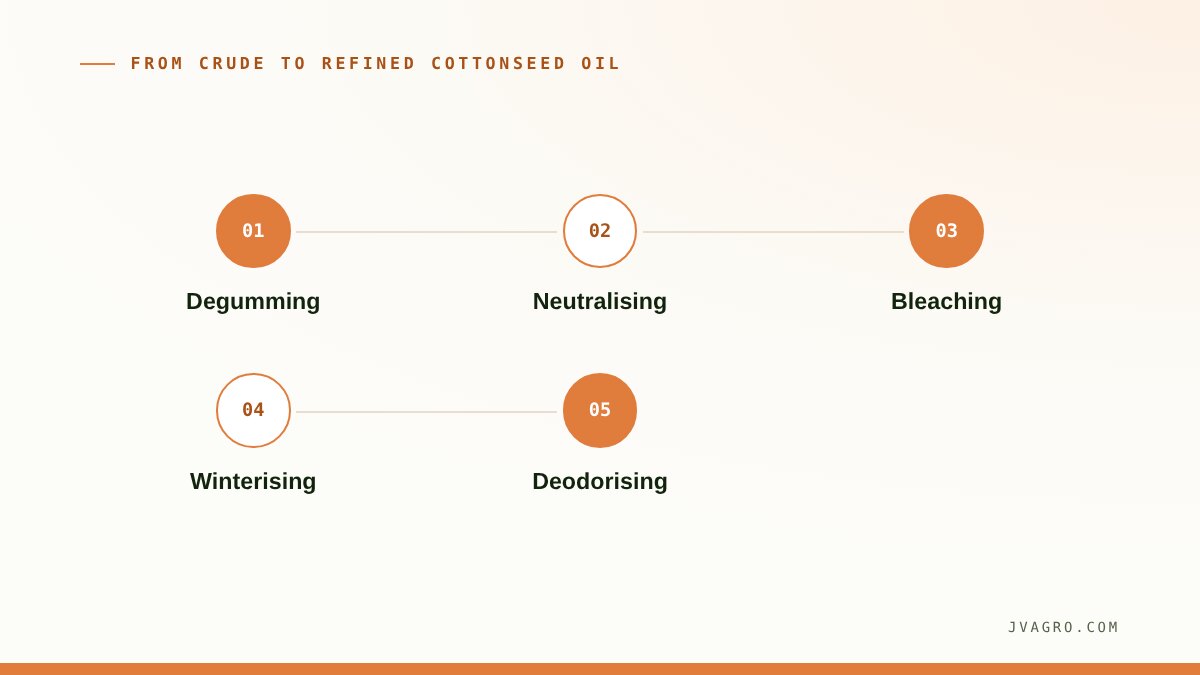
The refining steps
- DegummingWater or acid treatment removes gums and phosphatides.
- NeutralisingAlkali removes free fatty acids as soapstock. This is where most refining loss happens, and why FFA matters so much.
- BleachingBleaching earth removes pigments, including gossypol-derived colour.
- WinterisingChilling removes waxes and solid fats so the oil stays clear in cool weather.
- DeodorisingSteam under vacuum strips out odour and taste compounds.
Why fresh crude is worth more
FFA rises as crude oil ages, especially in heat and with moisture present. Every point of FFA means more loss in neutralising. Oil from a mill close to the refinery, delivered fast in clean tankers or drums, refines more efficiently. That is why location and freshness are part of the price.
HSN codes
Crude cottonseed oil falls under HSN 1512 21, and refined cottonseed oil under 1512 29. GST rates on edible oils change from time to time; check the current CBIC schedule.
Handling and storage
- Keep containers clean and dry: water raises FFA.
- Avoid heat and sunlight: they darken oil and speed up deterioration.
- Do not mix old and new lots: one old lot raises the FFA of the whole tank.
- Sample from the top, middle and bottom of a tanker before unloading.
Quick answers
No. Crude cottonseed oil contains gossypol and other impurities and must be refined before use as food.
Free fatty acids. They are removed during neutralising, and higher FFA means higher refining loss. Fresh, well-stored crude has lower FFA.
HSN 1512 21 covers crude cottonseed oil. Refined cottonseed oil falls under 1512 29.
Buying crude cottonseed oil? Fresh crude cottonseed oil from our Vidarbha unit, by tanker or drum.