
Compliance
GST on dal and pulses: when it is 0%, when it is 5%, and the 25 kg rule
The same dal can attract 0% or 5% GST depending on how it is packed and labelled. Here is the rule, with examples every trader, packer and kirana owner meets every day.
Key takeaways
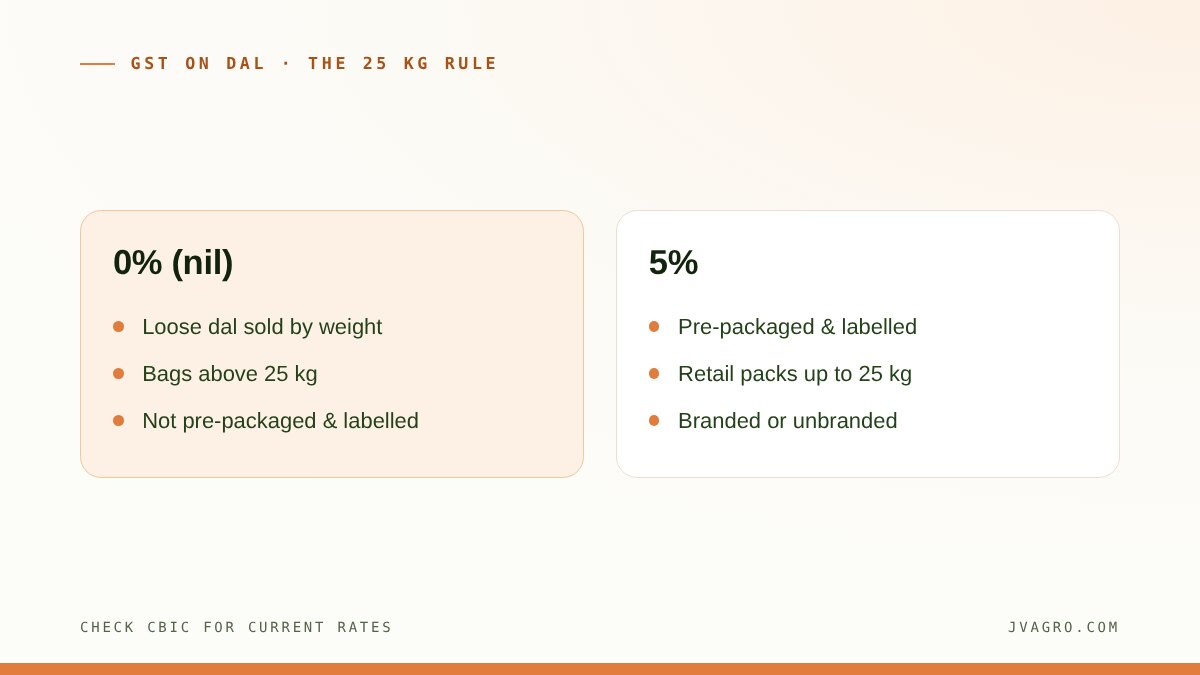
- Loose dal sold by weight, not pre-packed, is exempt (0%).
- Pre-packaged and labelled dal in a pack of up to 25 kg attracts 5% GST, branded or not.
- Packs above 25 kg fall outside the pre-packaged and labelled definition used for GST, and are generally exempt.
- Rates and definitions change by notification. Confirm with your tax adviser and the CBIC rate schedule before you invoice.
Until July 2022, GST on pulses depended on whether the dal carried a registered brand. From 18 July 2022 the test changed to whether the product is "pre-packaged and labelled". That one change is why the rules now turn on pack size and labelling rather than branding.
The rule in one table
| Situation | Example | GST |
|---|---|---|
| Loose | Weighed out at the shop | Nil |
| Bulk bag above 25 kg | 30 kg or 50 kg bag | Nil, outside the pre-packaged and labelled definition |
| Retail pack of 25 kg or less | 500 g, 1 kg, 5 kg, 25 kg, pre-packaged and labelled | 5% |
| Multi-pack | Small labelled packs inside a carton | 5% on each pack |
Based on CBIC's FAQs on GST applicability on pre-packaged and labelled goods (July 2022). The Legal Metrology (Packaged Commodities) Rules define pre-packaged commodities. Always confirm the current position on the CBIC rate schedule and with a chartered accountant.
What "pre-packaged and labelled" means
A commodity is pre-packaged when it is packed without the buyer being present and the quantity is predetermined. If such a pack must carry the Legal Metrology declarations, such as net quantity, maker, date and price, it is pre-packaged and labelled for GST purposes. Retail packs of dal up to 25 kg fall in this category.
Common situations
A kirana owner who sells loose and packed dal
Loose dal weighed out for the customer: nil. A 1 kg packet from a brand on the shelf: 5%.
A restaurant buying 30 kg bags
Bags above 25 kg are generally outside the definition, so they are typically exempt. For a large kitchen, buying in 30 or 50 kg bags can avoid GST on the dal itself, but check with your adviser for your specific invoice.
A repacker buying bulk and selling 1 kg packs
Buys in bulk at nil, sells labelled 1 kg packs at 5%. The repacker charges and pays GST on its outward supply.
A private label brand
When a mill packs dal into labelled retail packs for another brand, the packs are pre-packaged and labelled and generally attract 5%. Agree in writing who issues which invoice.
Did GST 2.0 change this?
The GST rate rationalisation that took effect on 22 September 2025 reorganised most goods into two main slabs. Pulses continued to follow the same broad structure: nil when loose, and a concessional rate when pre-packaged and labelled. Because rates and entries are amended from time to time, always check the latest notified schedule.
HSN code for dal
Most pulses, whole or split, fall under HSN heading 0713. Tur is 0713 60 00, kabuli chana 0713 20 10, desi chana (Bengal gram) 0713 20 20. Full list in our HSN codes for pulses guide.
This is general information to help you ask the right questions. It is not tax advice. Your chartered accountant should confirm the rate on every invoice type you issue.
Quick answers
Loose toor dal is exempt. Pre-packaged and labelled toor dal in packs up to 25 kg attracts 5% GST.
Packs above 25 kg fall outside the pre-packaged and labelled definition used for GST, and are generally exempt. Confirm with your tax adviser.
Yes, if it is pre-packaged and labelled in a pack of 25 kg or less, GST at 5% applies even without a brand.
Pulses continued to follow the same broad structure after 22 September 2025: nil when loose and a concessional rate when pre-packaged and labelled. Check the current CBIC schedule.
Sources
Buying dal in bulk for a kitchen or a repacking unit? We supply in 25, 30 and 50 kg bags and in labelled retail packs. Ask for both rates.