Compliance
FSSAI licence for a dal business: registration, state or central?
Every business that mills, packs, stores, distributes or sells dal needs FSSAI registration or a licence. Which one depends on turnover and what you do. Here is the decision in one page.
Key takeaways
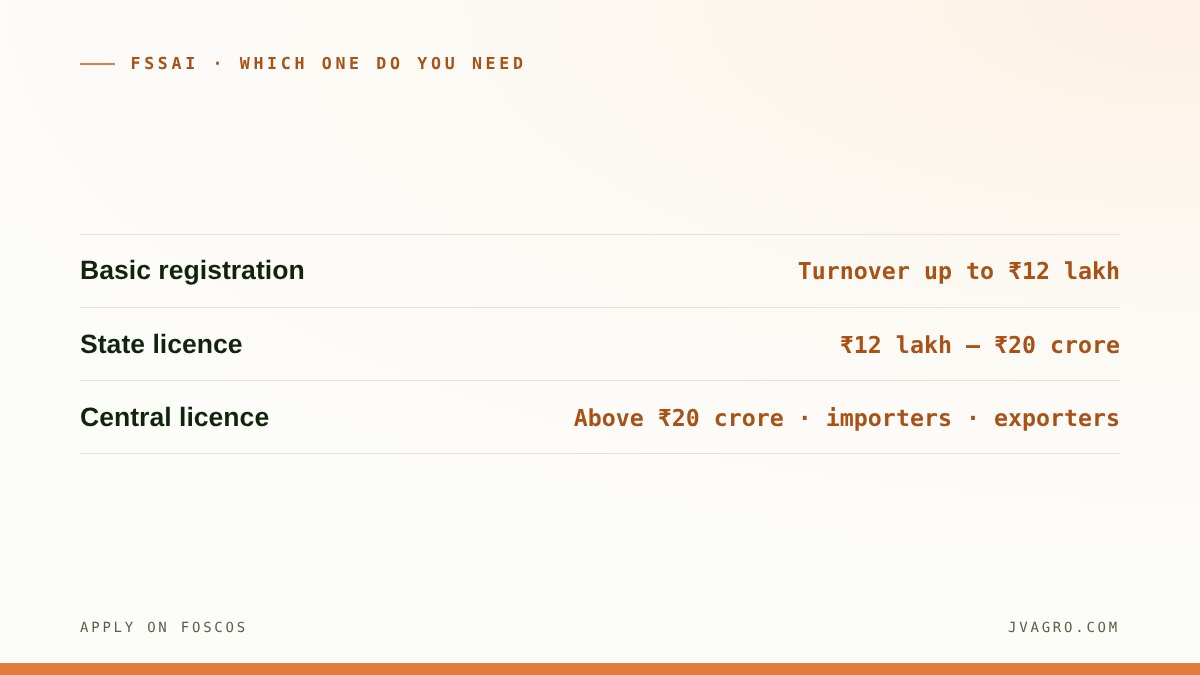
- Basic FSSAI registration: annual turnover up to ₹12 lakh.
- State licence: turnover above ₹12 lakh and up to ₹20 crore.
- Central licence: turnover above ₹20 crore, and for importers and exporters and certain other categories regardless of turnover.
- Apply and renew online on the FSSAI FoSCoS portal. Operating without one is an offence under the FSS Act.
Under the Food Safety and Standards Act, 2006, every food business operator must be registered or licensed. For a dal business, that means millers, packers, traders, distributors, wholesalers, retailers, exporters and online sellers.
Which one you need
| Category | Who it is for | Typical annual fee |
|---|---|---|
| Basic registration | Petty food businesses with turnover up to ₹12 lakh | ₹100 |
| State licence | Turnover above ₹12 lakh and up to ₹20 crore, and manufacturers within the state's capacity limits | ₹2,000 to ₹5,000 |
| Central licence | Turnover above ₹20 crore; importers; exporters; operators in multiple states and certain other categories | ₹7,500 |
Thresholds and fees are those commonly cited for FSSAI's licensing categories. Manufacturing units also have capacity-based criteria. Check the current schedules on the FoSCoS portal for your exact activity.
Which kind of dal business needs what
A small kirana or local trader
If turnover is within ₹12 lakh, basic registration is enough. Above that, a state licence.
A distributor or wholesaler
Usually a state licence. Distributors who move goods across several states may need a central licence for a head office and state licences for premises.
A dal mill or repacker
A manufacturing licence for the premises, state or central depending on turnover and capacity. The licence must list the product categories you make.
An exporter or importer
A central licence is required for import and export, regardless of turnover. Importers also need an IEC from DGFT.
An online seller
You need your own registration or licence for your business and premises. Marketplaces ask for it during onboarding and show your licence number on the listing.
Documents you will typically need
- Identity and address proof of the proprietor, partners or directors.
- Proof of possession of the premises: rent agreement or ownership document.
- List of food categories you will handle.
- For manufacturers: layout plan, list of equipment, water test report and a food safety management plan.
- Constitution documents for a company or partnership.
Renewal and display
Licences and registrations are issued for one to five years. Renew before expiry; late renewal attracts a penalty and an expired licence means you cannot operate. Display the certificate at the premises. Your FSSAI number must appear on every pre-packed label.
What happens without a licence
Operating without registration or a licence is an offence under Section 63 of the FSS Act, punishable with imprisonment of up to six months and a fine of up to ₹5 lakh.
If you are launching a private label dal brand, the mill that packs for you holds its own manufacturing licence. You still need your own registration or licence as the brand owner and seller, and both licence numbers usually appear on the pack.
Quick answers
Basic registration for turnover up to ₹12 lakh, a state licence from ₹12 lakh to ₹20 crore, and a central licence above ₹20 crore or for importing and exporting.
Yes. Exporters and importers of food need a central FSSAI licence regardless of turnover.
Basic registration is ₹100 a year. State licences are typically ₹2,000 to ₹5,000 a year and central licences ₹7,500 a year.
Sources
Starting a dal brand or distributorship? We supply FSSAI-licensed, fully labelled dal for distributors and private label brands.