Market
India's pulses in numbers: production, imports and the 2030 target
The world's biggest grower of pulses still imports. Five numbers explain why.
Key takeaways
- Chana is the backbone: about 45% of the 2024-25 crop.
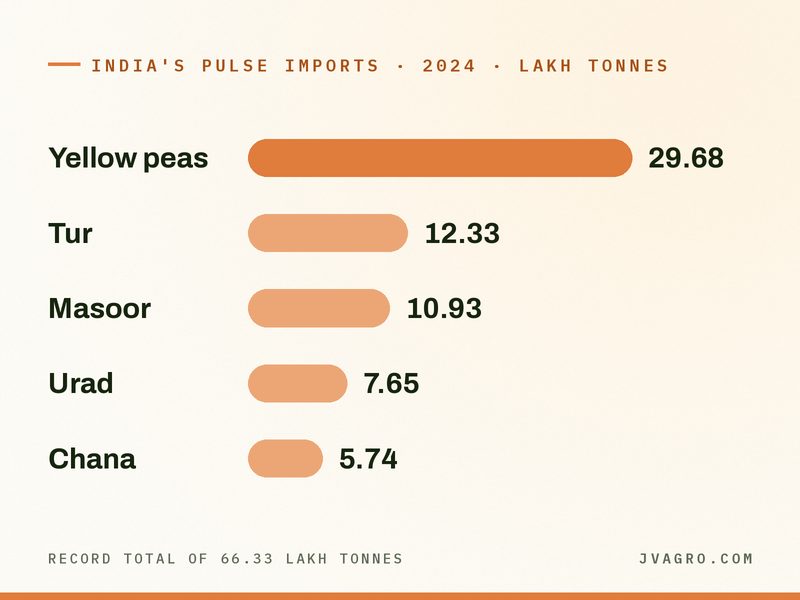
- Imports almost doubled in 2024, led by yellow peas and a record 12.33 lakh tonnes of tur.
- A ₹11,440 crore mission aims to close the gap by 2030-31.
Why a top producer still imports
India is also the world's largest consumer of pulses, and most of its kharif pulses, tur, moong and urad, are rain-fed. One weak monsoon and the shortfall shows up as imports within months.
| Pulse | Imports in 2024 (lakh tonnes) |
|---|---|
| Yellow peas | 29.68 |
| Tur | 12.33 |
| Masoor | 10.93 |
| Urad | 7.65 |
| Chana | 5.74 |
What changes by 2030
The Mission for Aatmanirbharta in Pulses targets 350 lakh tonnes from 310 lakh hectares by 2030-31, backed by free seed kits, assured procurement of tur, urad and masoor, and support for 1,000 new processing units.
Quick answers
Chana (gram). At 11.33 million tonnes it was about 45% of India's 25.23 million tonne pulse crop in 2024-25 (Third Advance Estimates).
An estimated 66.33 lakh tonnes, a record, led by yellow peas (29.68 lakh tonnes) and tur (12.33 lakh tonnes).
Sources
Buying or packing pulses? Tell us the product, quantity and destination and we will come back with a number.