
Quality
Moisture in dal and pulses: safe levels, meters and why 1% costs you money
Moisture is the cheapest thing to sell and the most expensive thing to buy. One extra percent in a truck of dal is a hundred kilos of water you paid dal prices for.
Key takeaways
- FSSAI's legal maximum moisture for tur dal is 14%. Good commercial lots are well below it.
- Wet grain heats, moulds and attracts insects. Moisture is the root cause of most storage losses.
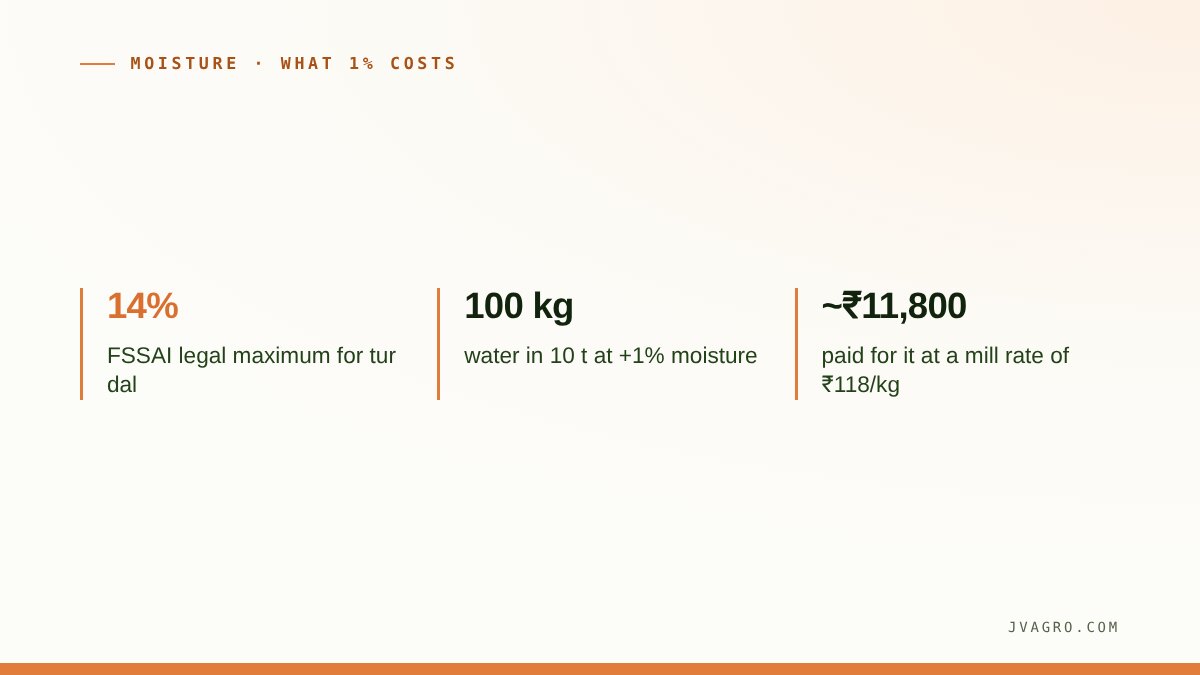
- One extra percent in 10 tonnes is 100 kg of water bought at dal prices.
- Use a calibrated grain moisture meter on a fair sample; the oven method is the reference.
In the pulse trade, moisture is both a quality issue and a money issue. It decides how long a lot keeps, and it is part of the weight you pay for. A buyer who never checks it is paying for water.
Safe moisture levels
| Product | Legal maximum | What good lots usually show |
|---|---|---|
| Tur dal | 14% (FSSAI) | Comfortably below the limit |
| Chana dal | 14% (FSSAI) | Comfortably below the limit |
| Whole chana and kabuli | 14% (FSSAI, whole pulses) | Lower for long storage |
Legal limits are from the Food Safety and Standards (Food Products Standards) Regulations. Exact commercial targets depend on season, packing and how long the stock must keep. Agree a figure in your contract.
Why moisture matters
- Spoilage: damp grain respires, warms up and becomes a home for moulds and insects such as the pulse beetle.
- Smell and taste: damp dal turns musty and loses its fresh flavour.
- Cooking: very dry, old dal may take longer to cook. Very damp dal can sprout or ferment.
- Weight: water is part of the weight you pay for.
What 1% costs you
In 10 tonnes of dal, every percentage point of moisture is 100 kg of water. At a mill rate of ₹118 a kilo, one extra percent costs about ₹11,800 on a single truck. Over a year of deliveries, it adds up fast.
How to test moisture
- Draw a fair sampleFrom several bags and several depths, mixed on a clean sheet.
- Use a calibrated meterA capacitance or resistance grain moisture meter set for the specific pulse. Readings for tur and chana differ, so pick the right setting.
- Check temperatureVery hot or very cold grain can mislead a meter. Let it reach room temperature.
- Record and retainNote the reading on the delivery challan and keep a sealed sample.
- Use the oven method for disputesThe laboratory air-oven method is the reference test.
The feel test, when you have no meter
Good dry dal rattles when you shake a handful, feels slightly warm rather than cool, and does not stick together. Bite a grain: dry dal cracks cleanly, damp dal squashes. It is no substitute for a meter, but it catches the worst lots.
Keeping dal dry after delivery
Store on pallets, away from walls, in a dry and ventilated godown, with the oldest stock moving first. Do not stack bags against damp floors. In the monsoon, check stock every week. More in our full guide on how to store dal.
Quick answers
FSSAI's legal maximum for tur dal is 14% by weight. For long storage, good lots are kept comfortably below that.
With a calibrated grain moisture meter on a fair sample, set for the specific pulse. The laboratory oven method is the reference for disputes.
Damp grain respires and warms up, which encourages moulds and insects and leads to musty smells and losses.
Want dal that is dried before it leaves? Every lot is checked for moisture before despatch. Ask us for the reading with your quote.