
Private label
Private label dal: what goes into the cost of a 1 kg pack
Before you launch a dal brand, you need to know what a 1 kg pack really costs to make. Here is every line in the costing, with a worked example you can adapt.
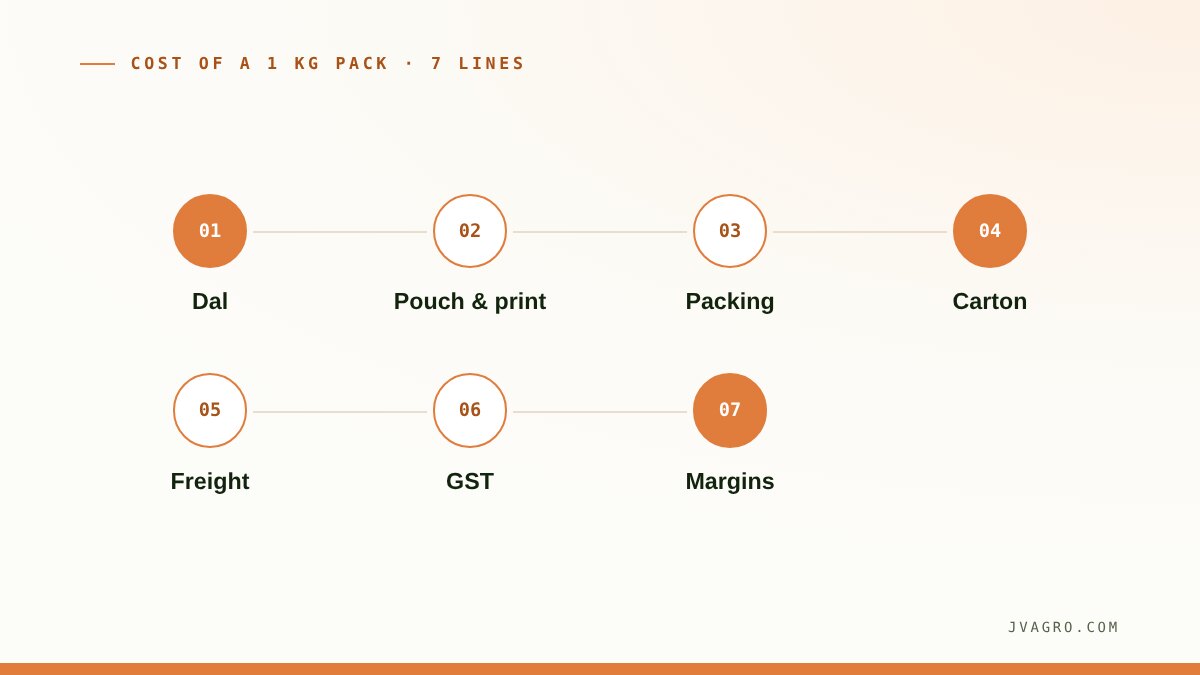
Key takeaways
- The dal itself is usually the largest cost, by far. It moves with the market every day.
- Pouch, printing and packing are the next layer. Printed rolls have minimum order quantities, so plan your designs.
- GST at 5% applies to pre-packaged and labelled packs up to 25 kg.
- Price your MRP to leave room for distributor and retailer margins, or for marketplace fees if you sell online.
Most new dal brands fail on costing, not on quality. They price off the dal rate on the day they launch and forget everything that sits between the mill and the shelf. Here is the full stack.
The seven lines of cost
- DalThe mill rate for the grade you choose, per kilo. Tur dal costs more than chana dal; unpolished, bold and sorted grades cost more than ordinary ones. This line changes with the market.
- Pouch and printingA laminated, printed pouch or a printed roll for form-fill-seal packing. Cost depends on material, size, number of colours and order quantity. Zipper pouches cost more than plain pillow packs.
- PackingWeighing, filling, sealing, batch coding and quality checks. Automated lines cost less per pack at volume.
- Secondary packingCartons or bales that hold 10, 20 or 30 packs for transport.
- FreightFrom the mill to your warehouse or distributor.
- GST5% on pre-packaged and labelled dal up to 25 kg. Input credit on packaging can be used against output GST.
- MarginsYour own margin, plus the distributor's and retailer's, or the marketplace's commission and fees.
A worked example (illustrative)
| Line | Assumption | ₹ per pack |
|---|---|---|
| Dal | Assumed mill rate of ₹120/kg | 120.00 |
| Pouch and printing | Laminated printed pouch | 5.00 |
| Packing and coding | Filling, sealing, batch code | 2.00 |
| Carton share | 1/20 of a carton | 1.00 |
| Freight to warehouse | Assumed | 2.00 |
| Cost before GST | 130.00 | |
| GST at 5% | On the selling price, shown here on cost for simplicity | 6.50 |
Every figure above is an assumption for illustration. Your real numbers depend on the day's dal rate, grade, pouch specification, volumes and distance. Ask for a current quote.
From a landed cost of about ₹130 before tax, a brand then adds its own margin, the distributor's margin and the retailer's margin to arrive at a selling price and MRP. Online, replace distributor and retailer margins with marketplace commission, fulfilment and advertising.
Where brands lose money
- Fixing MRP too low at launch and being unable to raise it when dal rates rise.
- Ordering too many printed pouches of one design, then changing the design.
- Ignoring damages and returns, which are real in retail and online.
- Forgetting the working capital tied up in stock and in credit to distributors.
How to protect your margin
- Agree a pricing formula with the mill that links to a published or agreed reference, rather than renegotiating every order.
- Keep packaging flexible: a common pouch with a variety sticker or a printed band can reduce minimum order quantities.
- Start with fewer products and add the range once the first ones move.
A good private label partner will show you the costing, not just a final rate. Ask for the dal rate, grade and packing cost separately so you can see what changes when the market moves.
Quick answers
It depends on the mill and the pouch. Printed pouches and rolls have their own minimums from the printer. Ask the mill for its minimum batch and the printer's minimum run.
Yes. The packing mill holds its manufacturing licence, and the brand owner needs its own registration or licence as the marketer and seller.
Pre-packaged and labelled dal in packs up to 25 kg attracts 5% GST.
Sources
Launching your own dal brand? We mill, sort and pack under your label, in 500 g to 30 kg packs, with all FSSAI and Legal Metrology declarations.