
Process
What a Sortex does to dal: colour sorting explained
"Sortex cleaned" is one of the most common phrases on a dal quote. Here is what the machine actually does, grain by grain, and what it can and cannot fix.
Key takeaways
- A colour sorter uses high-speed cameras and air jets to reject grains that look wrong, one by one.
- It removes discoloured, black-tipped, insect-damaged and immature grains, and many stones and foreign seeds.
- "Sortex" is a brand name that the trade now uses for any optical sorter.
- Sorting improves look and safety, but cannot fix old, damp or poorly milled dal.
The name comes from Sortex, a British company (now part of Bühler) that pioneered optical sorting. In the Indian grain trade, "Sortex" now means any colour sorter, and "Sortex dal" means dal that has passed through one.
How it works
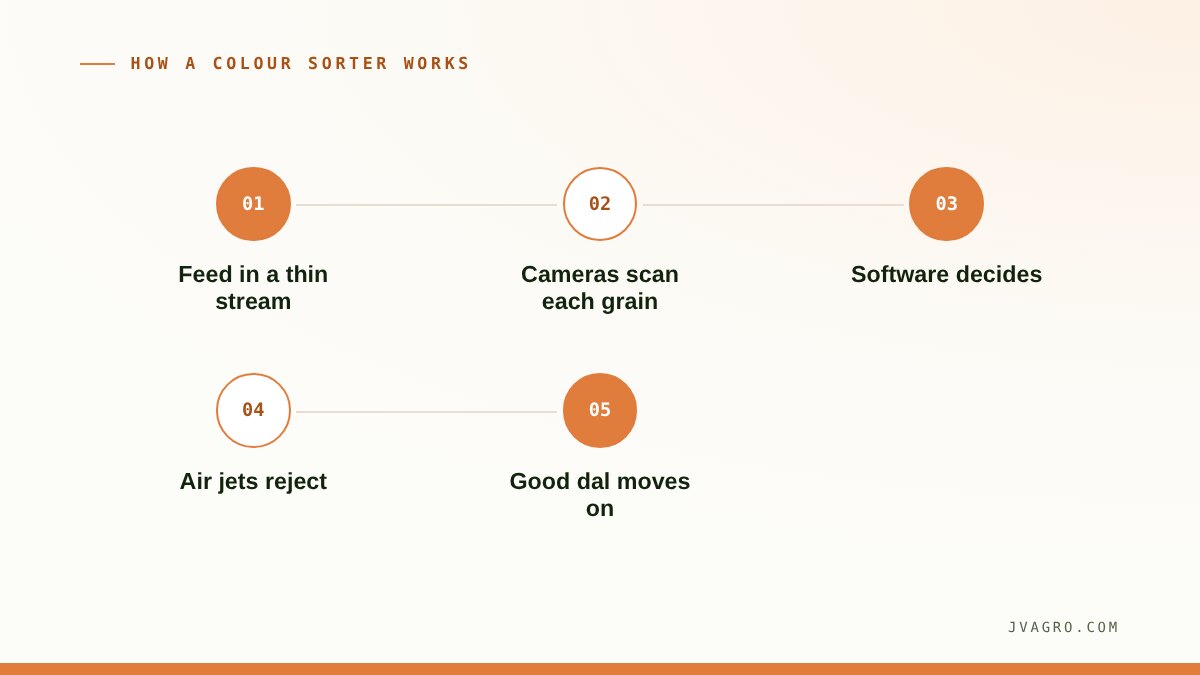
- FeedDal flows from a hopper onto vibrating trays and chutes that spread it into a thin, single layer of fast-moving grains.
- ScanAs grains fall, high-resolution cameras view each one from one or both sides, against a reference background, in visible and sometimes infrared light.
- DecideSoftware compares every grain with the settings for an acceptable grain: colour, shade, spots, size and shape.
- RejectWhen a grain fails, a precisely timed puff of compressed air from an ejector knocks it out of the stream into a reject chute.
- AcceptGood grains continue to the next stage. Rejects are often re-sorted to recover good grains caught in the air blast.
What a sorter removes
- Discoloured grains: dark, brown, green or immature.
- Black-tipped and spotted grains.
- Insect-damaged grains with visible holes or marks.
- Foreign matter: many stones, mud balls, husk and seeds of other crops.
- Grains of a different pulse if they differ clearly in colour.
What a sorter cannot fix
- Old dal: it may look fine and still cook poorly.
- Damp dal: moisture is not visible to a colour camera.
- Hidden insect infestation: eggs and larvae inside grains may pass.
- Poor milling: bad de-husking or excess brokens are a milling problem.
- Chemical contamination: residues are invisible.
Why sorted dal costs a little more
Sorting rejects a share of grains that would otherwise be sold, uses power and compressed air, and needs skilled settings. The result is a cleaner, more uniform lot with fewer complaints. For retail packs, sorted dal is now standard. For institutional buyers, it is worth asking whether the price includes sorting.
When a supplier says "Sortex", ask two follow-up questions: how many passes, and what is the reject rate? A single quick pass on a poor lot leaves more behind than two careful passes on a good one.
Quick answers
Dal that has passed through an optical colour sorter, which rejects discoloured, damaged and foreign grains one by one using cameras and air jets.
Sorted dal is cleaner and more uniform. It does not guarantee freshness or correct moisture, so those still need checking.
It removes many stones and mud balls that differ in colour from dal. Mills also use destoners and sieves before sorting.
Want sorted, unpolished dal? Every lot of our dal passes through colour sorting before packing.