
Market
Toor dal price today: why it is ₹131 a kilo in shops, and what the mill rate is
The all-India average retail price of tur dal crossed ₹131 a kilo in October 2026. Here is where every rupee of that price comes from, from the farm gate to the shelf.
Key takeaways
- The all-India average retail price of tur dal was ₹131.06 a kilo on 16 October 2026, up 13.7% in a year.
- That shelf price includes the raw tur, milling loss, the mill's cost, packing, GST on packed dal, freight, the distributor and the shop.
- Buying in bulk at the mill rate removes two or three of those layers.
- Tur sowing was slightly higher this year, but a weak monsoon in pulse states keeps the market firm until the new crop arrives.
"Why is toor dal so expensive?" is one of the most searched questions about food in India, and the honest answer is that tur dal is expensive to make. It is milled from a single-season crop, a third of the grain is lost as husk and brokens, and India still imports a large share of what it eats.
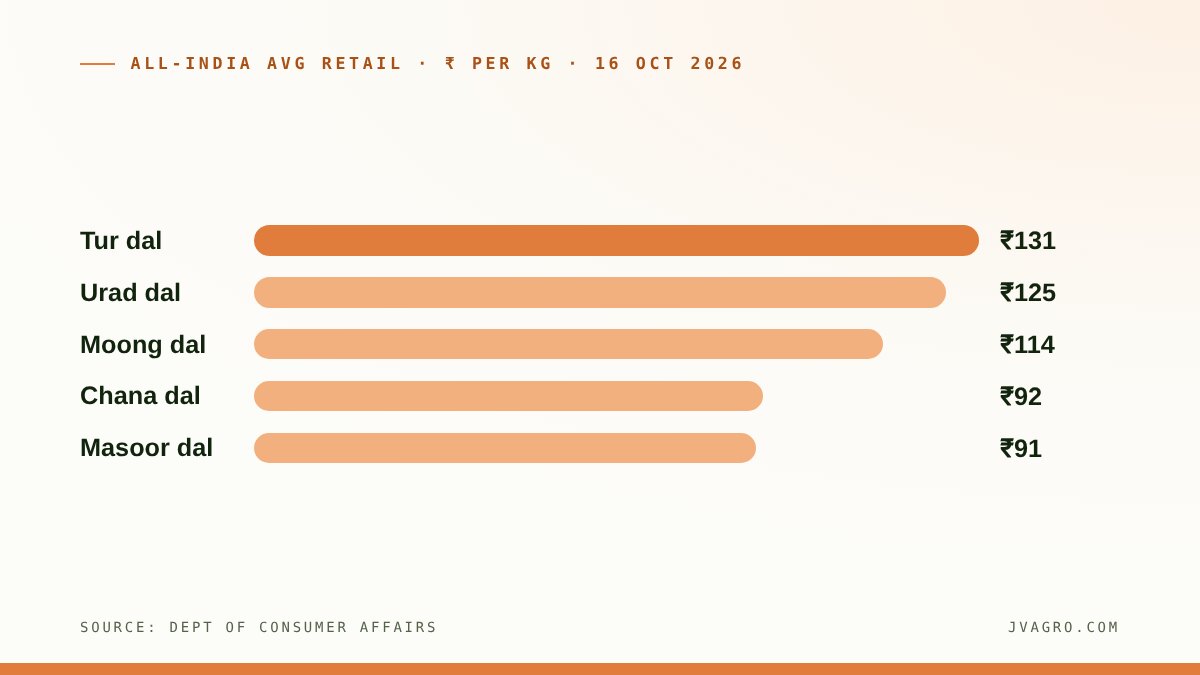
What dal costs in shops right now
Source: Department of Consumer Affairs price monitoring data as reported by AgroSpectrum India. Prices vary widely by city and brand. Year-on-year, tur dal was up 13.7%, urad 9.9% and chana dal 5.7%.
How the price of a kilo of tur dal is built
- Raw tur at the mandiThe farmer sells whole tur at the APMC or to a trader. The government's support price for 2026-27 is ₹8,450 a quintal, and market rates are often higher.
- Mandi chargesMarket fee, hamali, weighing and the commission agent's charge are added to the bid price.
- Milling recoveryAbout 68 to 75 kg of dal comes out of 100 kg of tur. The rest is husk, brokens and powder, which sell for much less. This one step adds roughly a third to the grain cost of every kilo of dal.
- Milling cost and marginPower, labour, sorting, bags and the mill's margin.
- Packing and GSTPre-packed, labelled dal attracts 5% GST. Loose dal does not.
- FreightFrom the mill to the distributor's godown, often hundreds of kilometres.
- Distributor and retailer marginsThe distributor carries stock and gives credit; the shop pays rent and takes the final margin.
Why retail is so much higher than the mill rate
Each layer is reasonable on its own. Together they add up. Branded dal in a supermarket also carries marketing, shelf fees and the cost of returns. That is why a restaurant, caterer or kirana chain buying 10 quintals a month can save meaningfully by buying at the mill rate, delivered, instead of buying from a wholesaler who bought from a distributor.
If you are comparing quotes, always ask three things: is it polished or unpolished, what is the grade, and is the price ex-mill or delivered? Two rates that look ₹5 apart can be the same deal.
Why prices are firm in late 2026
Tur sowing for 2026-27 reached 46.11 lakh hectares by mid-September, slightly above last year. But the monsoon was weak in several pulse-growing states, and the crop will not reach mandis until December. Until then, the market runs on old stock and imports. Tur imports are allowed duty-free until 31 March 2027, which caps how high prices can go.
When do toor dal prices usually fall?
Typically in the arrival window, from late December to March, when new tur floods into mandis in Maharashtra, Karnataka and Telangana. That is the season most mills, wholesalers and large kitchens use to lock in stock. Read our explainer on why toor dal prices move for the full calendar.
Quick answers
The all-India average retail price of tur dal was ₹131.06 per kg on 16 October 2026, according to Department of Consumer Affairs data. Bulk mill rates are lower; see our daily rate board for the current ex-mill rate.
Tur is a single-season crop, only about 70% of the grain becomes dal after milling, India imports part of its supply, and packing, GST, freight and two or three trade margins are added before it reaches a shop.
Usually from late December to March, when the new tur crop arrives in mandis and supply is at its highest.
Pre-packed and labelled tur dal attracts 5% GST. Loose, unbranded tur dal sold without a label is exempt.
Sources
Buying more than a few quintals? Buy at the mill rate instead of the shelf price. Rates are posted every working day.