
Buying
Chana dal wholesale: grades, sizes and what decides the rate
Chana dal is bought for three very different jobs: cooking, grinding into besan and frying into namkeen. Each one needs a slightly different lot. Here is how to buy the right one.
Key takeaways
- Chana dal is made from desi chana, the small dark chickpea, not kabuli chana.
- Grade by grain size, colour, brokens and moisture. Bold even dal suits kitchens; flour mills care more about dryness and flavour.
- The rate follows raw chana, besan demand and yellow pea prices.
- Chana MSP for the 2027-28 crop is ₹5,958 a quintal.
Chana dal is split, de-husked desi chana. It is the second most important dal in Maharashtra after tur, and the base of besan, which in turn is the base of half of India's snacks. That gives chana dal a broader set of buyers than any other dal, and a price that responds to all of them.
Three buyers, three specifications
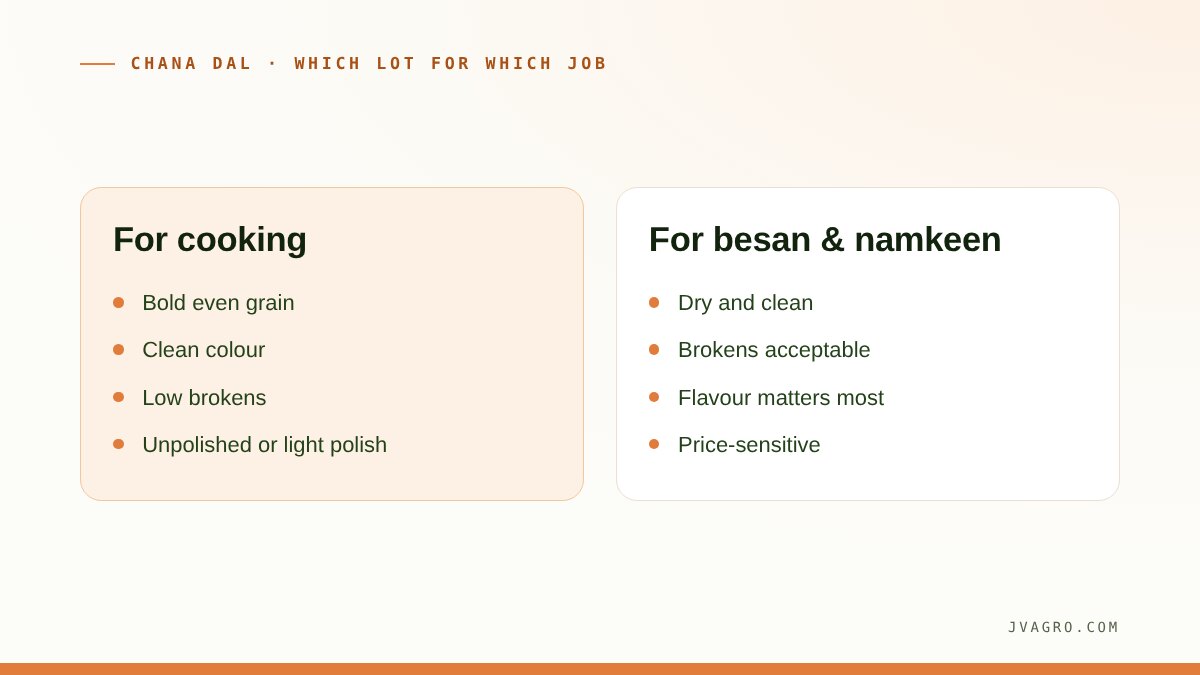
Kitchens and restaurants
Want bold, even grains with clean colour and few brokens, because chana dal is often served visibly whole in dal fry, chana dal tadka and Maharashtrian dishes like puran and amti.
Besan and flour mills
Care most about dryness, cleanliness and flavour. Brokens are fine, since everything is ground. A slightly roasted, nutty flavour in the finished flour starts with good chana.
Namkeen and snack makers
Often buy chana dal for frying whole, so size and uniformity matter, as does low moisture so the dal fries crisp.
What decides the rate
- Raw desi chana prices at mandis in Maharashtra, Madhya Pradesh and Rajasthan.
- Milling recovery: chana gives more dal than tur, roughly 74 to 80 kg from 100 kg of clean grain.
- Besan demand: festive months and wedding seasons push flour mills to buy more.
- Yellow peas: when cheap peas are available, flour mills switch part of their demand and chana softens.
- The season: new chana arrives from late February, and prices usually ease into March and April.
Quality checks for chana dal
| Check | Good sign | Warning sign |
|---|---|---|
| Colour | Even pale to golden yellow | Dark, dull or patchy grains |
| Size | Uniform halves | Mixed sizes and many fragments |
| Smell | Clean, mild, nutty | Musty, stale or chemical |
| Moisture | Feels dry, rattles in the hand | Soft, cool or sticks together |
| Foreign matter | Almost none | Husk, stones, other seeds |
Unpolished chana dal
As with tur, a lot of retail chana dal is polished to look brighter. Our Swastik chana dal is sold unpolished, with no oil coating. For a kitchen, the difference is small; for retail shoppers who read labels, it is a selling point.
Ex-mill vs delivered
Chana dal is heavy and freight matters. A rate that looks cheaper from a distant mill may cost more delivered. Always compare landed cost per kilo, including freight and unloading.
Quick answers
No. Chana dal is made from desi chana, the small dark-skinned chickpea, which is de-husked and split. Kabuli chana is the large cream chickpea used whole for chole.
It moves daily with raw chana prices and besan demand. See our rate board for today's ex-mill chana dal rate.
Clean, dry desi chana dal with good flavour. Size matters less because it is ground, but moisture and cleanliness matter a lot.
Need chana dal by the truck or by the quintal? We mill desi chana dal at Paratwada and Yavatmal and supply kitchens, flour mills and packers.