Market
Yellow peas vs chana: how cheap imports move chana dal and besan prices
Yellow peas look nothing like chana dal on a plate, but in a flour mill they compete head to head. That is why one import decision can move chana prices across India.
Key takeaways
- Yellow peas are a cheaper substitute for chana in besan, namkeen and some dal blends.
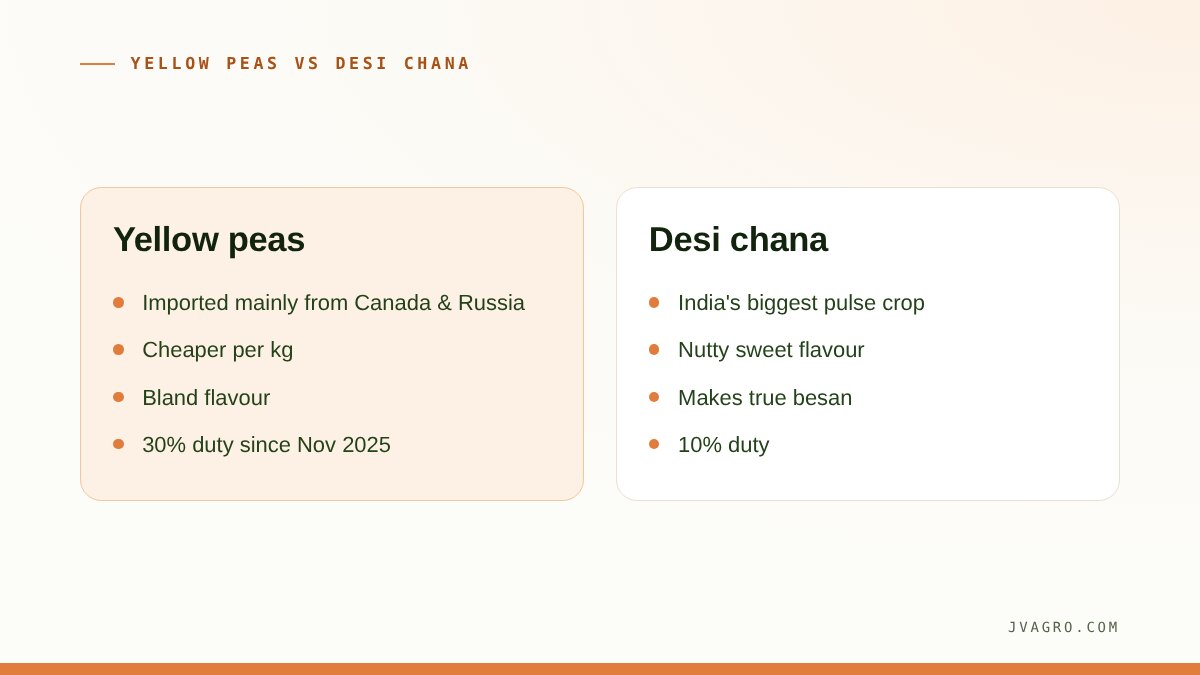
- Large duty-free imports in 2024 and 2025 pulled chana prices down; a 30% duty since November 2025 has reduced that pressure.
- Pure besan is made only from chana dal. FSSAI requires any blend to be declared on the label.
- If you buy chana dal for flour, compare against pea flour landed cost, not just last month's chana rate.
Yellow peas (matar) are the dried seeds of the field pea, grown mainly in Canada, Russia and Australia. They are cheap, easy to split and grind into a pale yellow flour. Desi chana is India's largest pulse crop and the only legitimate source of besan. In a market where both are flour, they compete.
Where yellow peas compete with chana
- Besan and gram flour blends, where pea flour is mixed in to cut cost.
- Namkeen and fried snacks, where many recipes tolerate pea flour or matar dal.
- Roasted and fried dal, where split peas can stand in for chana dal.
- Cheap dal blends for institutional buyers.
What happened in 2024 and 2025
With chana prices high, India allowed duty-free imports of yellow peas from December 2023 and extended the window several times. Imports reached record levels. Flour mills and snack makers switched part of their demand from chana to peas, and domestic chana prices weakened, which hurt farmers at harvest. In response, a 30% import duty was imposed from 1 November 2025.
What the 30% duty changed
With duty, landed pea prices rose and the gap with chana narrowed. Chana regained some demand from flour mills. The trade still watches pea arrivals closely: every time the government signals a change in the pea duty, chana dal and besan prices react within days.
If you buy chana dal for besan or snacks, track two numbers every week: the ex-mill chana dal rate and the landed price of yellow peas including duty. The gap between them tells you where chana dal is heading.
How to tell pure besan from pea-mixed besan
Pure besan has a warm, slightly nutty smell, a pale yellow-cream colour and a fine texture. Pea flour is brighter yellow and tastes flatter. At home, the most reliable signs are taste and behaviour in cooking: pure besan pakora batter holds better and has a distinct roasted flavour. Labs can test for adulteration accurately; at home it is a judgement. The legal point is simpler: if a flour contains anything other than chana dal, the label must say so.
What it means for chana dal buyers
For kitchens that cook chana dal as dal, peas are not a substitute; the flavour and texture are different. For flour mills and snack makers, they are. That is why chana dal sold for flour often moves faster and more sharply than chana dal sold for kitchens.
Quick answers
For flour and some snacks, yes, but the flavour is flatter. As cooked dal, yellow peas taste and behave differently. Pure besan is made only from chana dal.
30%, in force since 1 November 2025, with online registration of import contracts.
Because flour mills and snack makers can partly switch from chana to cheaper yellow peas, so heavy pea imports reduce demand for chana.
Sources
Buying chana dal for besan or snacks? Clean, dry desi chana dal from our mills, graded for flour and namkeen makers.