Policy
Pulses import duty in India 2026: tur, urad, chana, masoor and yellow peas
Five pulses, five different import rules. One table that every dal trader, importer and mill needs, and why each rule moves domestic prices.
Key takeaways
- Tur and urad: free import, no duty, until 31 March 2027.
- Chana and masoor: 10% duty, with no duty on imports from least developed countries.
- Yellow peas: free to import but 30% duty, with online contract registration.
- Duty rules change by notification, often at short notice. Always check DGFT and CBIC before you contract.
India is the world's largest producer of pulses and also one of the largest importers. The import rules decide how far domestic prices can rise before foreign pulses become cheaper, so they move every rate in the trade, from mandi tur to a kilo of besan.
The rules as of late 2026
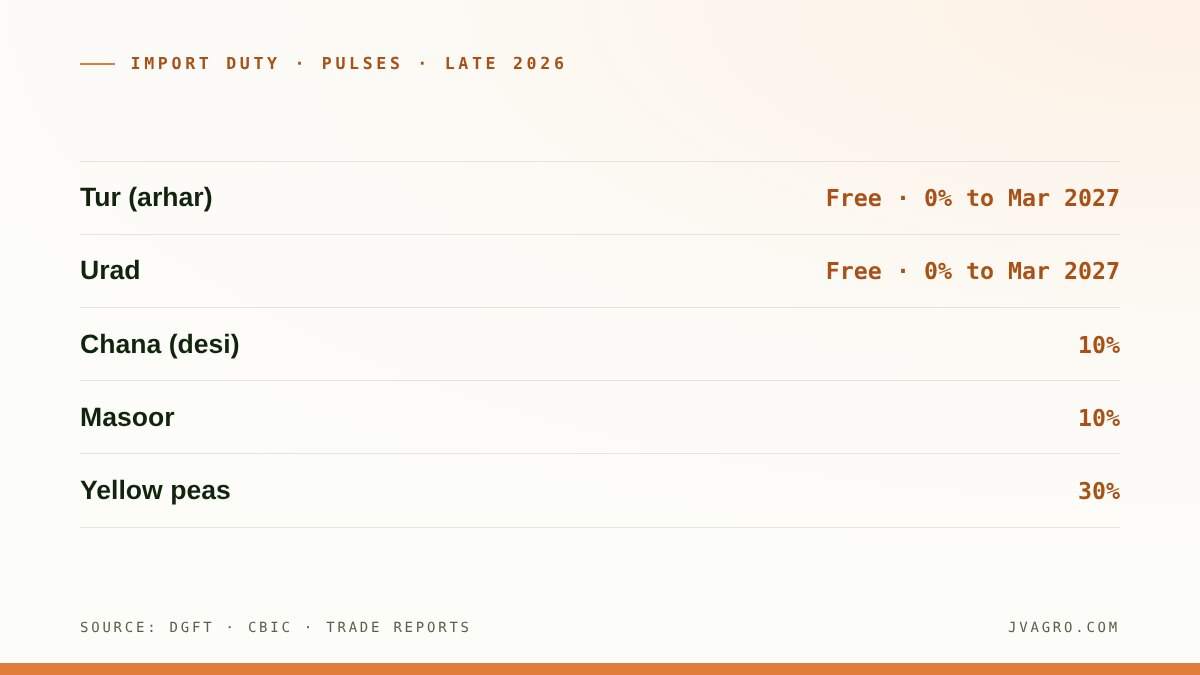
| Pulse | Import policy | Basic customs duty | Valid until |
|---|---|---|---|
| Tur (arhar, pigeon pea) | Free | Nil | 31 March 2027 |
| Urad (black gram) | Free | Nil | 31 March 2027 |
| Chana (desi chickpea) | Free | 10% | Until changed |
| Masoor (lentil) | Free | 10% | Until changed |
| Yellow peas | Free, with contract registration | 30% | Until changed |
Compiled from DGFT notifications and trade reports to October 2026. Least developed countries get preferential access on some lines. In October 2026, reports said the government was considering cutting duty on lentils and yellow peas; no decision had been announced at the time of writing.
Tur and urad: the open door
Tur and urad are the two pulses where India's own crop falls furthest short of demand. Both have been kept in the free category without duty for several years and the window was extended again to 31 March 2027. The effect is a ceiling on domestic prices: if Indian tur rises far above the landed cost of tur from Mozambique, Tanzania or Myanmar, imports flow in.
Chana and masoor: a moderate wall
Chana is India's biggest pulse crop and the country is close to self-sufficient. A 10% duty protects farmers without shutting imports entirely. Masoor is different: India imports a lot of it, mainly from Canada and Australia, and the 10% duty is a balance between protecting farmers and keeping dal affordable.
Yellow peas: the 30% wall
Yellow peas are not a traditional Indian dal, but they are a cheap substitute for chana in besan, snacks and some dal blends. After very large duty-free imports in 2024 and 2025, a 30% duty was imposed from 1 November 2025. Imports are still allowed, but each contract must be registered online. The duty matters to chana: when yellow peas are cheap, chana and besan prices soften.
How to read an import rule as a buyer
The quick test: compare the landed cost of the imported pulse, including duty, freight, port charges and milling, with the domestic rate for the same grade. If imports are cheaper, domestic prices usually cannot rise much further. If they are dearer, the domestic crop sets the price.
What to check before you sign an import contract
- The DGFT notification number and its validity date for the exact HS code you are importing.
- The basic customs duty and any cess on the CBIC tariff.
- Registration requirements, such as the Import Monitoring System for some pulses.
- Bill of lading date, because some relaxations apply only to shipments loaded before a cut-off.
- FSSAI import clearance for food-grade lots at the port.
Quick answers
No. Tur (pigeon pea) imports are free and duty-free until 31 March 2027.
Desi chana attracts a 10% basic customs duty, as reported in October 2026.
Yellow peas attract a 30% duty, in force since 1 November 2025, and import contracts must be registered online.
Masoor (lentil) attracts 10% duty, as reported in October 2026. The government was reported to be considering a cut.
Sources
Importing or trading pulses? We mill Indian tur and chana and can quote against import parity for the same grade.