
Process
How besan is made: from chana dal to gram flour
Besan is one ingredient with one rule: it is ground from chana dal. Here is how a flour mill turns dal into fine and coarse besan, and why some besan tastes better than others.
Key takeaways
- Besan is flour of de-husked chana dal. FSSAI defines it that way; anything else blended in must be declared.
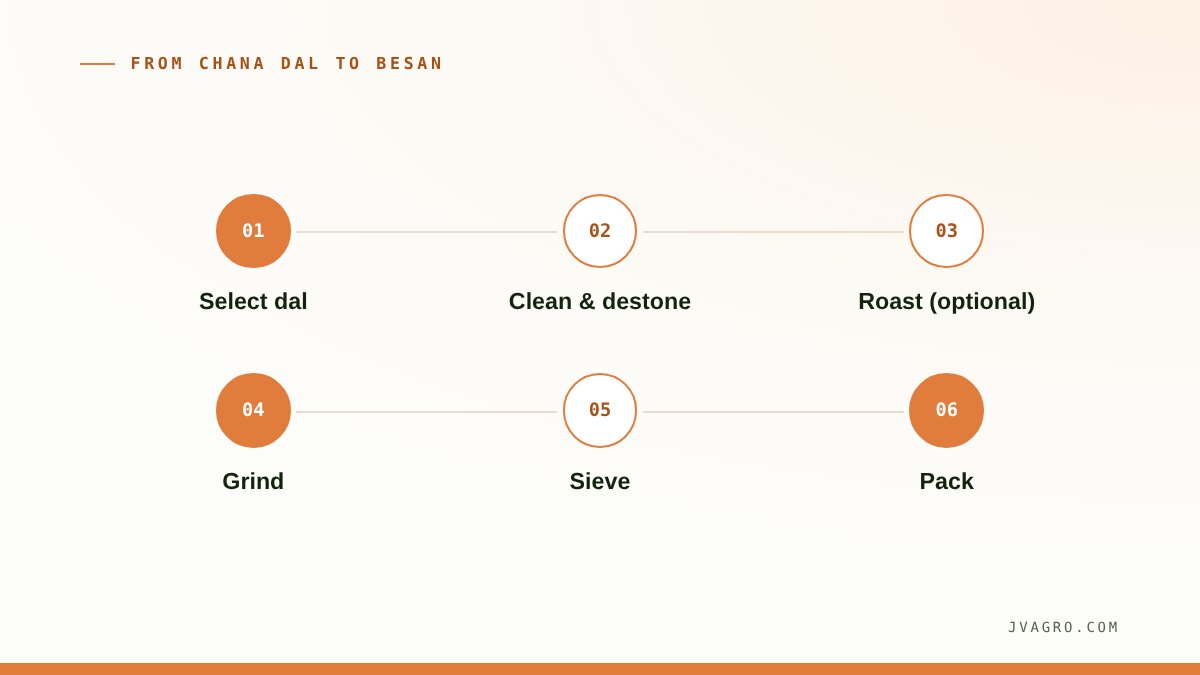
- The process is cleaning, optional light roasting, grinding, sieving and cooling before packing.
- Fine besan suits batters and sweets like mysore pak; coarse besan suits ladoo and some snacks.
- Flavour starts with the chana dal: clean, dry, fresh dal gives a nutty, sweet besan.
Besan sits behind half of India's snacks and sweets: pakoras, dhokla, kadhi, sev, boondi, ladoo and mysore pak. It is made from chana dal, and the quality of the dal decides the quality of the flour.
The process
- Select the dalClean, dry, de-husked desi chana dal. Old or damp dal gives a stale flour that does not keep.
- Clean and destoneSieves, aspirators and destoners remove dust, husk, stones and metal. Magnets catch iron particles.
- Roast (optional)Some mills lightly roast or heat the dal. It deepens the nutty flavour and lowers moisture, which helps shelf life.
- GrindPulverisers, hammer mills, stone chakkis or roller mills grind the dal. Grinding generates heat; too much can spoil flavour, so good mills control speed and cooling.
- SieveThe flour is sifted through meshes to separate fine and coarse grades. Oversize particles return to the grinder.
- Cool and packWarm flour sweats in a bag. Cooling before packing prevents lumps and moisture problems.
Fine besan vs coarse besan
| Grade | Texture | Best for |
|---|---|---|
| Fine | Smooth, powdery | Pakora and bhajji batter, dhokla, kadhi, mysore pak |
| Medium | Slight grain | General cooking, sev, chilla |
| Coarse (ladoo besan) | Grainy, like fine rava | Besan ladoo, some namkeen |
Pure besan and blends
FSSAI's standard describes besan as the product of grinding de-husked Bengal gram, without added colour or other foreign matter. Some flours in the market are blended with pea flour or other pulse flours to cut cost. A blend is not illegal if it is declared, but it cannot be sold as pure besan. See yellow peas and chana prices for why blending rises and falls with pea prices.
Why some besan tastes better
- Fresh chana dal from the current or recent crop.
- Controlled grinding temperature, so the flavour is not cooked off.
- Light roasting in some styles.
- Fresh packing: besan picks up moisture and smells, and goes stale faster than whole dal.
Storing besan
Keep besan airtight, cool and dry. It keeps for a few months; in hot, humid weather, buy smaller quantities. A bitter or rancid smell means it is past its best.
If you run a besan unit, your margin depends on chana dal cost, recovery of fine grade and how fast you sell. Dry, clean dal improves all three.
Quick answers
Besan is made by grinding de-husked desi chana (chana dal). FSSAI describes it as the product of grinding de-husked Bengal gram.
Fine besan is powdery and suits batters and sweets like mysore pak. Coarse besan is grainy and suits besan ladoo and some snacks.
Pure besan has a warm, nutty smell and a pale yellow-cream colour. Blends must be declared on the label. A laboratory test confirms purity.
Buying chana dal for a besan unit? Clean, dry desi chana dal from our mills, graded for flour milling.