Business
Dal mill project report: capacity, machinery, costs and what really drives profit
Most dal mill project reports get the machinery list right and the economics wrong. Written by a family that has run dal mills since 1992, this is what actually decides whether a mill makes money.
Key takeaways
- A dal mill's profit comes from recovery, by-product value, capacity use and working capital, not from the machinery itself.
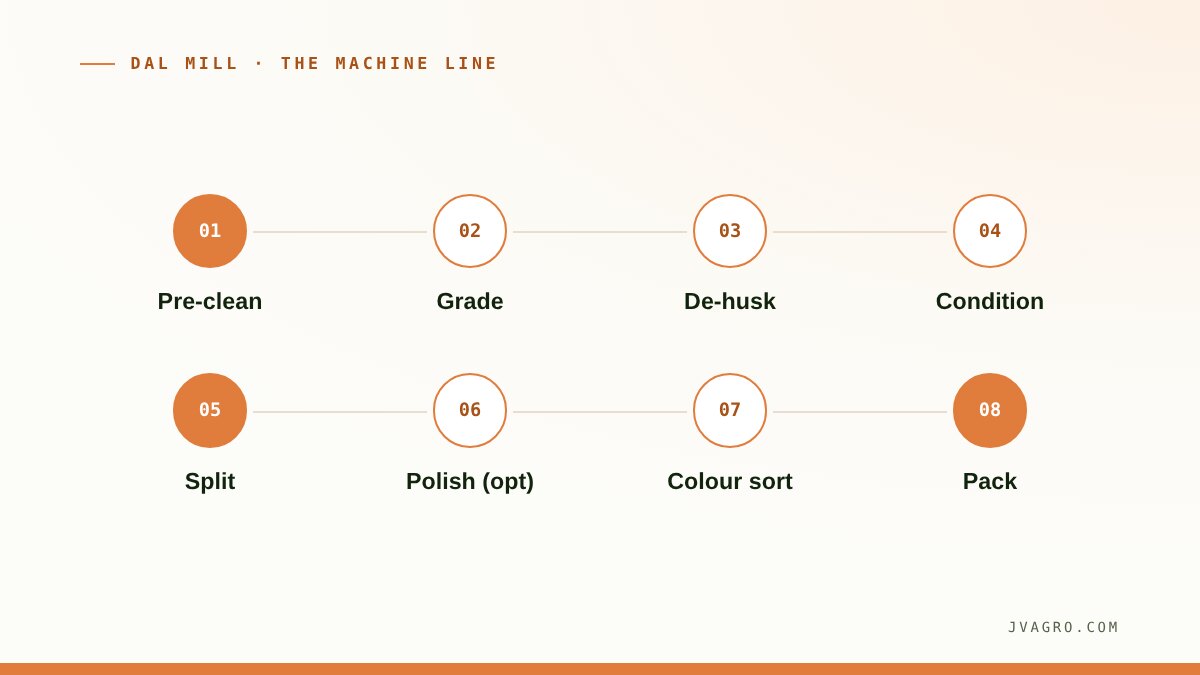
- The machine line is cleaning, grading, de-husking, conditioning, splitting, optional polishing, colour sorting and packing.
- Working capital to buy grain in the arrival season is usually the largest money need.
- Micro units may be eligible for a credit-linked subsidy under PMFME of 35% of eligible project cost, up to ₹10 lakh. Check current scheme rules.
India has thousands of dal mills, from small units in market towns to large plants in Latur, Indore, Akola, Gulbarga and Jalgaon. The ones that last share a few habits: they buy well, they recover well, they run full, and they never run out of cash in the arrival season.
1. Choose a capacity you can keep full
Capacity is usually stated in tonnes of raw grain per day. The common mistake is to build for a capacity you cannot buy grain for, or sell dal for. An idle mill still pays interest, salaries and minimum power charges. Start with the volume you can source and sell, and design the building so you can add machines later.
2. The machine line
- Pre-cleaningSieves and aspirators remove dust, straw and light impurities.
- Destoning and gradingDestoners remove stones; graders separate grain by size, because each size is milled separately for best recovery.
- Pitting or first de-huskingEmery rollers scratch the husk so it loosens.
- ConditioningTur is treated with oil and water, then dried in the sun or a dryer, to loosen the husk further. Chana needs less conditioning.
- De-husking and splittingRepeated passes through emery rollers and splitters separate husk and split the grain.
- Polishing (optional)For polished dal only.
- Colour sortingOptical sorters remove discoloured and damaged grains.
- Weighing and packingBulk bagging and, if you sell retail packs, form-fill-seal or pouch packing machines.
- Material handling and dust controlBucket elevators, conveyors, cyclones and dust collectors run through the whole line.
3. Land, building and utilities
- Land with good road access for trucks, ideally near a mandi or a pulse-growing belt.
- Building with a dry godown for grain and finished dal, a milling hall and, for tur, space or a dryer for conditioning.
- Power: a dal mill draws significant connected load; power cost per quintal is a key operating number.
- Water for conditioning and staff.
4. Licences and registrations
GST, FSSAI manufacturing licence, factory licence and pollution control consents as applicable in your state, Udyam registration as an MSME, and APMC trading licence if you buy in notified markets. Exporting adds IEC, APEDA and FSSAI central licence.
5. Working capital: the number that sinks mills
Tur arrives from December to March. A mill that wants to run all year must buy a large share of its grain in those months, or buy later at higher prices. That stock is cash locked up. Add credit to buyers, and working capital often exceeds the cost of machinery. Plan bank limits and warehouse receipt finance before you build.
6. How a mill actually earns
| Line | What drives it |
|---|---|
| Dal revenue | Recovery × dal price |
| By-product revenue | Brokens, chuni, husk × their prices |
| Grain cost | Mandi price plus market charges and freight |
| Processing cost | Power, labour, oil for conditioning, bags, maintenance |
| Overheads | Salaries, interest, insurance, depreciation |
| Margin | What is left, usually thin per quintal and made on volume |
A one-point improvement in recovery, on every quintal, for a whole year, is often worth more than a year's salary bill. That is why experienced millers obsess over grading and conditioning.
7. Schemes worth checking
- PMFME: credit-linked capital subsidy for micro food processing units, 35% of eligible project cost up to ₹10 lakh.
- Agriculture Infrastructure Fund: interest subvention on loans for eligible post-harvest infrastructure.
- CGTMSE: credit guarantee for collateral-free loans to MSMEs.
- State industrial and food processing policies, which may offer capital or power subsidies.
Scheme rules and eligibility change. Confirm with the scheme portal and your bank before you count on support.
8. A cheaper first step
If you want to build a dal brand, you do not need a mill on day one. Start with private label packing from an established mill, build sales, and invest in machinery once volumes justify it.
Quick answers
Pre-cleaner, destoner, grader, pitting and de-husking rollers, conditioning system or drying yard, splitter, optional polisher, colour sorter, packing machines, elevators and dust collectors.
Raw grain, by far. Working capital to buy grain in the arrival season is usually the largest financing need.
Micro units may qualify for PMFME's credit-linked subsidy of 35% of eligible project cost up to ₹10 lakh. Other central and state schemes may apply. Check current rules.
Typically about 68 to 75% for tur and about 74 to 80% for chana, depending on grain and milling.
Sources
Thinking of a dal brand without building a mill? We mill and pack under your label, so you can test the market before you invest in machinery.